AMD Signed OpenAI, Meta and Anthropic. Consensus Already Has Every Gigawatt.
Sep 21, 2026 · Advanced Micro Devices, Inc. (AMD) profitmonk
Summary
- AMD has contracted 14 gigawatts of Instinct deployment: OpenAI 6 GW, Meta up to 6 GW, Anthropic up to 2 GW, first shipments H2 2026 to H1 2027.
- Su says silicon is not the binding constraint, and about a quarter of AMD's advanced packaging sits outside TSMC's CoWoS line, where NVIDIA holds close to 60%.
- Converting the 11 undelivered gigawatts at the midpoint of management's own price band gives $118.2B of 2028 revenue and $21.93 of adjusted EPS.
- That is 4.0% below the $123.07B consensus revenue and 4.1% below the $22.87 consensus EPS, so a bull case needs demand outside the 14 GW.
- AMD's risk factors, filed February 2026, disclosed the power constraint and the customer-financing exposure five months before the company took them on.
A CEO Was Handed $30 Billion and Called It Too Small
On 4 August 2026, roughly fifty minutes into AMD's second-quarter earnings call, C.J. Muse of Cantor Fitzgerald did the arithmetic out loud. "If I take your data center guide, Lisa, it sort of implies Instinct revenues of $30 billion, give or take," he said. Lisa Su checked which year he meant, he confirmed 2027, and she raised her own guidance inside the answer. "I think what you're hearing from us is that your data center AI number is probably too low. And maybe back to Stacy's question without going into exact numbers, I think this notion of over 100% should consider be well over 100%."
A chief executive was handed a $30 billion estimate on a live call, told the analyst it was too small, and declined to say by how much. That refusal is the subject of this article. Every model of AMD's 2028, mine included, turns on one undisclosed number, revenue per gigawatt. Her only public guidance on it is "double-digit billions."
It has a price attached. On 22 September 2025, NVIDIA and OpenAI announced a letter of intent for at least 10 gigawatts of NVIDIA systems, with NVIDIA intending to invest up to $100B in OpenAI. Fourteen days later AMD announced its own deal with the same customer and inverted the structure. NVIDIA bought equity in its customer; AMD gave equity to its customer, a warrant for up to 160 million shares at one cent each. A warrant is the right to buy shares at a fixed price. At $608.11 that is $97.3B at stake, 2.81 times AMD's entire FY2025 revenue of $34.6B. The 10-K disposes of it in one sentence: "the warrant had no impact to our financial statements for the year ended December 27, 2025."
AMD Designs Processors and Owns No Factories
Advanced Micro Devices designs high-performance and AI computing silicon and manufactures none of it. It is headquartered at 2485 Augustine Drive in Santa Clara, California, and was incorporated in Delaware on 1 May 1969 by Jerry Sanders and seven colleagues out of Fairchild Semiconductor, listing publicly in 1972.
What it sells is processors. EPYC server CPUs go into data centres, Ryzen chips into laptops and desktops, and Instinct accelerators train and run AI models. Radeon parts render graphics, the Xilinx lines supply FPGAs and adaptive chips, and semi-custom silicon sits inside the PlayStation 5 and Xbox. TSMC, GLOBALFOUNDRIES, UMC and Samsung make the wafers, and assembly and test run through Tongfu, SPIL and KYEC.
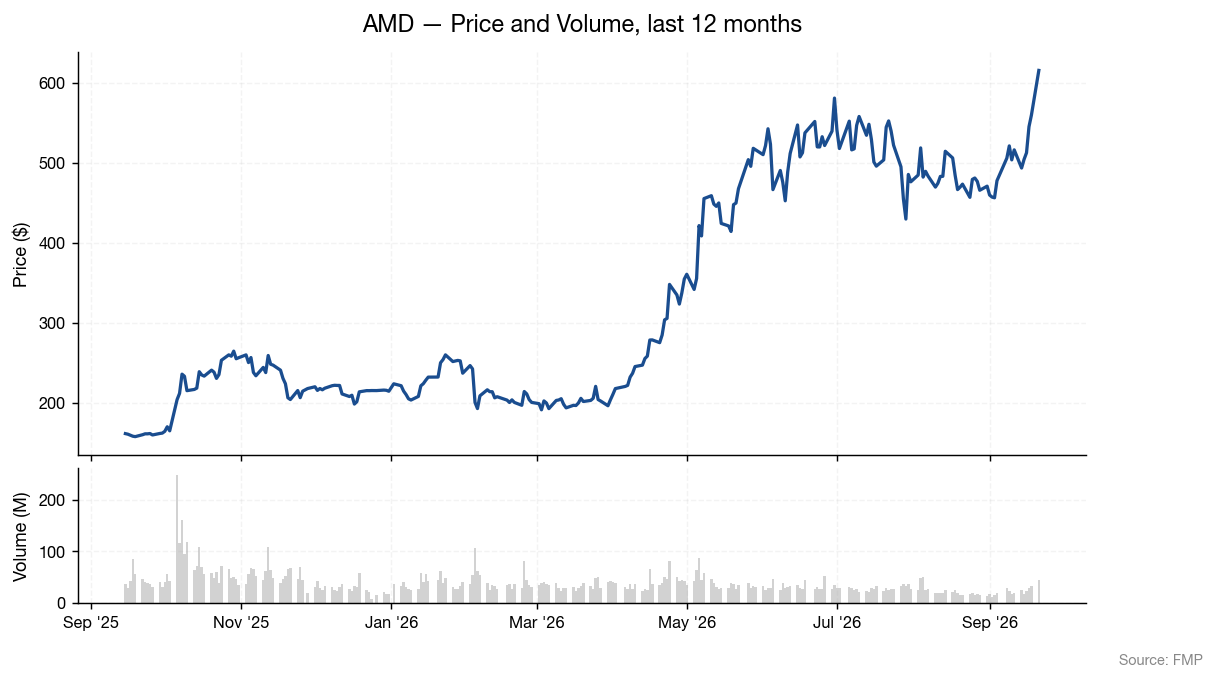
AMD employed about 31,000 people at 27 December 2025 and holds roughly 12,600 issued patents worldwide. International sales were 67% of net revenue in 2025 against 66% in 2024. The shares closed at $608.11 on 21 September 2026, for a market capitalisation of $991.58B.
Where the Money Actually Comes From
AMD reports three segments and talks about four, because Client and Gaming were combined from Q1 FY2025 while the call still breaks them out. Gross profit is not disclosed by segment, so operating income is the profitability line. Figures below are the June 2026 quarter against a year earlier.
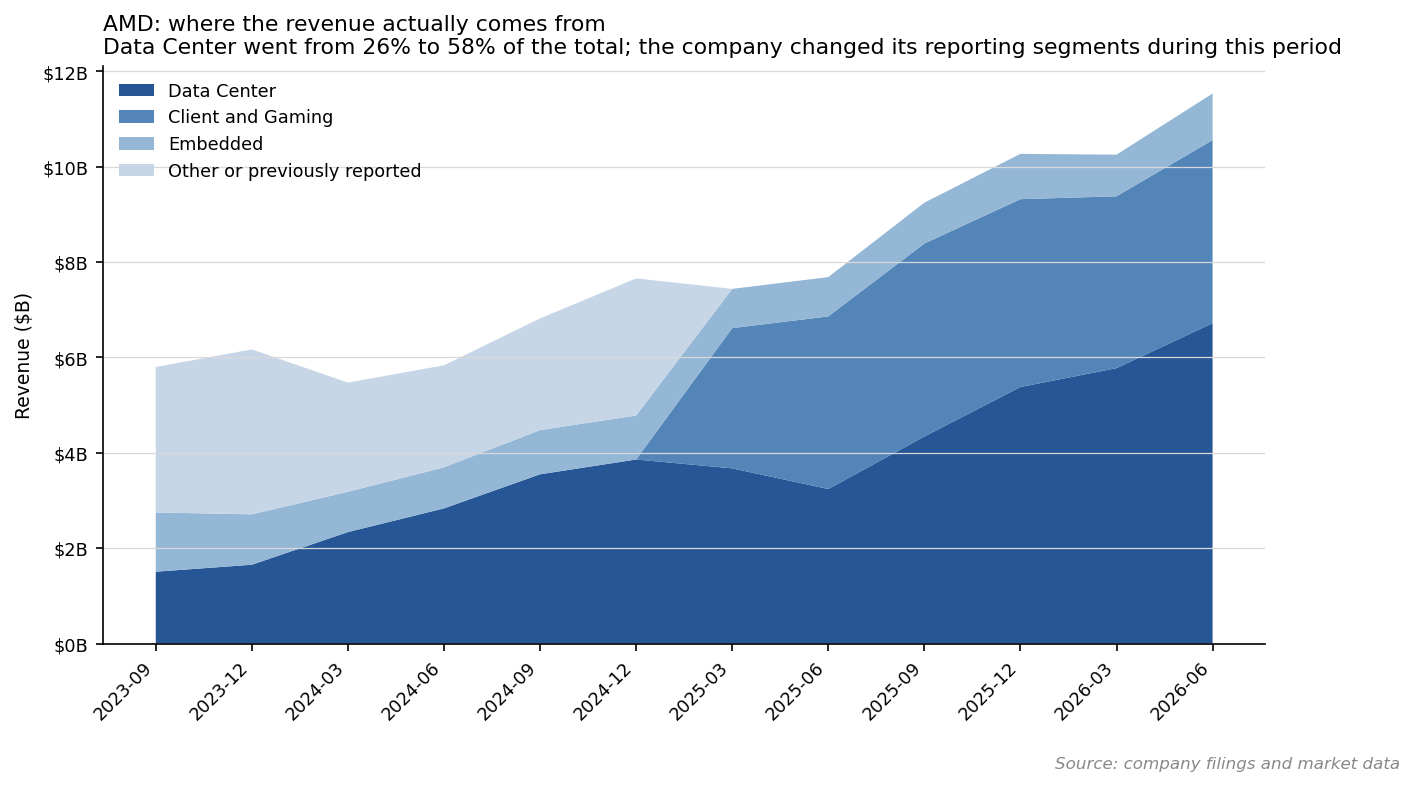
Data Center is the business that matters. It sells EPYC server processors, Instinct accelerators, FPGAs, Pensando networking silicon and Solarflare adapters. Revenue was $6.7B against roughly $3.24B, up 107%, on operating income of $2.1B at 31% of segment revenue. AMD credits EPYC sales up more than 70% year over year and Instinct revenue more than doubling on the MI350 ramp.
Client sells Ryzen, Ryzen Threadripper and Ryzen AI processors into notebooks and desktops. Revenue was $3.1B against about $2.52B, up 23%, which AMD credits to record mobile processor revenue.
Gaming sells the semi-custom chips inside both leading consoles, plus Radeon graphics cards. Revenue was $779M against about $1,129M, down 31%, attributed primarily to lower semi-custom revenue. Combined with Client, the segment earned $582M of operating income at 15% of revenue against $767M at 21%, on go-to-market investment and an expanding product road map.
Embedded sells industrial, automotive and networking parts, including EPYC Embedded and Versal adaptive SoCs. Revenue was $977M against about $821M, up 19%. Operating income was $386M at 40% of revenue against $275M at 33%, on favourable product mix.
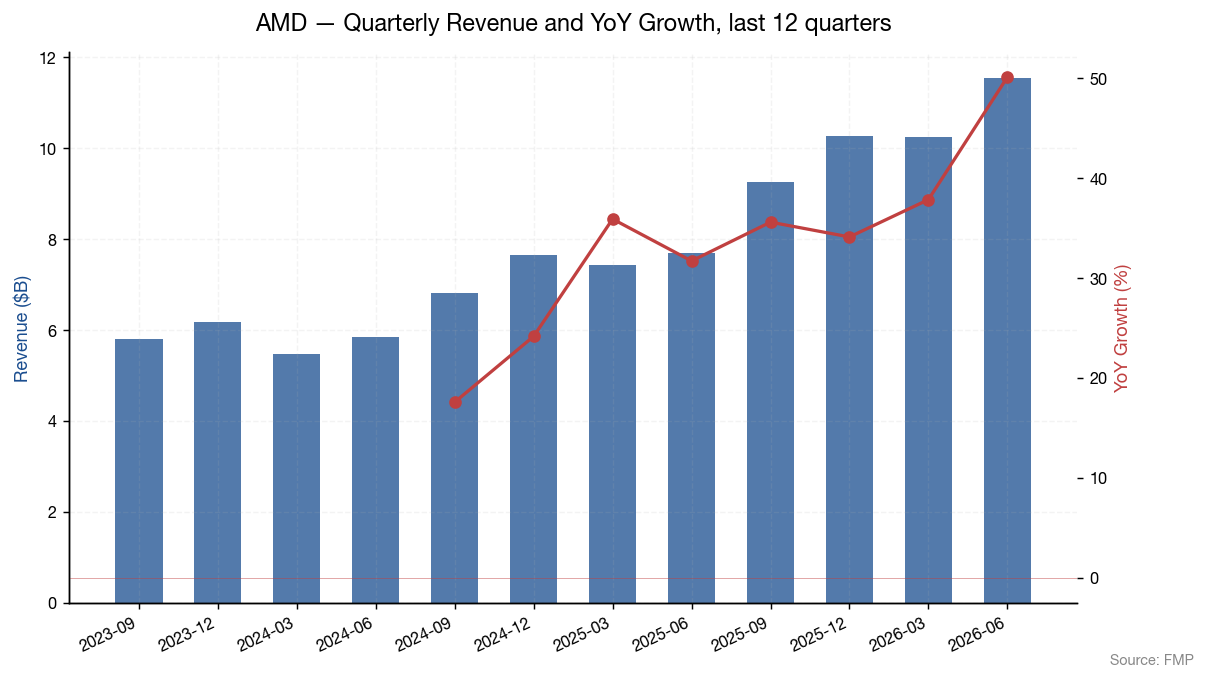
Consolidated revenue was $11.54B, up 50.1% year over year and 12.5% sequentially, with non-GAAP gross margin of 56% and adjusted EPS of $1.66, up 82%. Non-GAAP here excludes stock compensation and acquisition amortisation. Two facts fall out. Data Center is 58% of revenue against 42% a year ago, and the highest operating margin belongs to Embedded, at 40%, on 8.5% of the revenue.
The Order Book Is Now Written in Gigawatts
Three years ago the case for owning AMD was how much server share it could take from Intel. That case is still running: 34.5% of server processor units in Q2 2026 against 27.3% a year earlier, and 46.4% on a Xeon-SP-versus-EPYC basis, per Mercury Research on 21 August 2026. What is new is an order book denominated in gigawatts, signed inside a nine-and-a-half-month window. Before October 2025 the number was zero. Today it is 14.
Management also names the conditions it is working against. Its annual report, filed 4 February 2026, records a net $440M of inventory and related charges for FY2025, from US export controls on MI308 shipments to China. The US government also expects 15% of licensed China revenue. Embedded end-market demand "remained mixed" through 2025, and Su told the August call that AMD is "planning for a softer PC market as higher memory and component costs weigh on demand."
AMD Signed Three Frontier Labs in Under Ten Months
On 6 October 2025, AMD and OpenAI signed a definitive multi-year agreement to deploy 6 gigawatts of AMD accelerators, the first gigawatt of the MI450 part landing in H2 2026. A gigawatt is the power a deployed fleet draws at full load. The OpenAI warrant vests as deployment scales from 1 GW to 6 GW and expires in October 2030.
Meta followed on 24 February 2026 with up to 6 gigawatts, on a custom MI450-based accelerator paired with EPYC "Venice" processors inside AMD's Helios rack, first shipments also H2 2026. Anthropic signed on 22 July 2026 for up to 2 gigawatts in Helios, first gigawatt beginning H1 2027. AMD committed to invest up to $5B in Anthropic alongside it, and put Claude to work on AMD's software stack. Three signatures, 14 gigawatts, under ten months. 2028 is the year they convert or slide.
Operators buy power rather than chip count, because power is what their buildings and grid connections limit, which is why these contracts are written in gigawatts. The rest of the customer list sits at another scale. Oracle Cloud takes 50,000 GPUs from calendar Q3 2026. The MI455X draws 1,000 to 1,400 watts of thermal design power, the envelope a part is built to dissipate. That makes Oracle's order roughly 0.06 GW of silicon, about one one-hundredth of a frontier lab's commitment. Microsoft will deploy Helios on Azure at an undisclosed volume, and Su described customer pull as "tracking ahead of our initial forecast," meaning volumes.
The Constraint Moved Off AMD and Onto the Customer's Land
A book this size usually breaks on supply, and Su is unambiguous in the guided window. "We have supply to more than meet the guidance that we've talked about and the upside potential is there," she said on 4 August. Her qualifier governs 2028: "the range will depend on the ability to bring on more capacity in a timely fashion" at the operators. The constraint has moved to the customer's land, power and shell.
The physical bottleneck is advanced packaging. CoWoS, short for Chip-on-Wafer-on-Substrate, is TSMC's line that mounts a compute die and its memory stacks onto one substrate. NVIDIA, AMD and Broadcom queue for slots on it, and allocation decides who ships. TrendForce put industry-wide capacity, TSMC and the outsourced assemblers together, at close to 200,000 wafers a month by the end of 2026, with TSMC's own line at 120,000 to 140,000. Those three buyers take more than 85% of it. Silicon Analysts' Q1 2026 allocation review puts NVIDIA near 60%, Broadcom near 15% and AMD near 11%, with AMD drawing about 80,000 wafers from TSMC and about 25,000 from ASE and SPIL.
Memory is where AMD spends its differentiation. The MI455X carries 432 GB of HBM4 against the MI350's 288 GB of HBM3e. HBM4 is the fourth generation of High Bandwidth Memory, the stacked DRAM beside the compute die. Su claims "very good visibility into HBM allocation" for 2027, then volunteered that AMD can "modify that memory footprint if the total cost of ownership is not as significant in certain workloads." HBM4 pricing has been revised upward and supply is tight into 2027. A differentiator the seller offers to shrink feeds straight into the price assumption below.
Upstream the squeeze is easing. TrendForce has the packaging supply-demand gap narrowing from 20% to 10% by end-2026 and capacity doubling by 2028. The server CPU chain was tight through H1 2026 on unforecasted demand. Wafers, back-end capacity and substrates are being added for 2027, and chiplets let the 2-nanometer node ramp in fewer wafers.
Timing is the customer's. Su ties the 2028 range to operators bringing capacity on in time. Three first gigawatts must land between H2 2026 and H1 2027 on land, power and shell the buyers are still pouring.
What the Contracted Book Is Actually Worth
The book converts to dollars in two steps.
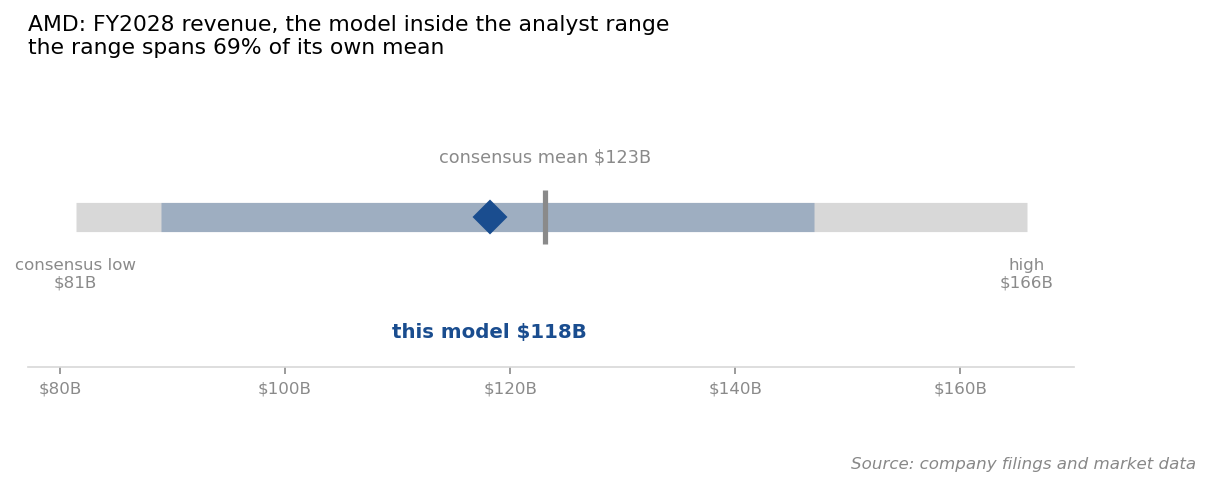
Three gigawatts are spoken for by date: OpenAI's first, Meta's first and Anthropic's first, all landing between H2 2026 and H1 2027. Bank of America's Vivek Arya put "about 3 gigawatts" to management on the August call as the 2027 run rate, and Su did not dispute it. That leaves 11 gigawatts undelivered. The only disclosed window runs to the warrant's October 2030 expiry, so spread evenly over three years, 2028 takes 3.67 gigawatts.
The price of a gigawatt is the number nobody outside AMD has. Asked on 4 August what one is worth, Su answered, "we've said double-digit billions. We're still in that range." The band has never been narrowed beyond $10B to $15B, and its midpoint is $12.5B. At that midpoint, 2028 Instinct revenue is $45.9B, with $36.7B at the bottom and $55.0B at the top. The same method gives $37.5B for 2027, above the roughly $30B Su told Muse was "probably too low."
The rest of the company is the weakest joint. Consensus FY2028 revenue is $123.07B, and Citi's Atif Malik carries $50.8B of 2028 AI GPU revenue, per Invezz and Barchart on 12 June 2026. Taking one house's AI line out of another's total leaves a non-Instinct base of $72.3B, a mixing of sources I label as such. Adding my Instinct range gives 2028 revenue of $109.0B, $118.2B and $127.3B.
Margin comes out of consensus too. FY2028 consensus EPS of $22.87 on roughly 1.66 billion diluted shares implies $38.0B of net income, a 30.8% net margin on $123.07B of revenue. Holding it across the three cases gives 2028 adjusted EPS of $20.22, $21.93 and $23.62, on the non-GAAP basis management guides. The full walk sits in the research brief published with this article.
The finding is that the contracts are already in the price. Base-case revenue of $118.2B is 4.0% below the consensus mean, and base-case EPS of $21.93 is 4.1% below $22.87. The whole band sits inside the consensus range of $81.39B to $165.89B. Building the book bottom-up and drawing it down evenly reproduces the Street. Manufacturing a disagreement here would be dishonest.
What the Street has not agreed is the rate. FY2028 consensus sits on a range equal to 69% of its mean, against 41% for FY2027 and 45% for FY2029. Ratings run 44 buy or strong-buy, 11 holds and no sells on 1 September 2026.
A genuine bull case has three sources. The first is a realized price above $15B per gigawatt, which the HBM4 content in a Helios rack argues for and de-speccing argues against. The second is demand outside the 14 gigawatts: Microsoft's Azure volume, Oracle's expansion beyond 50,000 GPUs, sovereign programs and mid-scale buyers. Cerebras reaches that last group with a Helios fast-inference solution live in Q4 2026. The third is a drawdown that front-loads, which is what "tracking ahead of our initial forecast" implies if it persists.
My anchor is Citi. My $45.9B of 2028 data center AI revenue sits 9.7% below Malik's $50.8B, and Citi uses identical arithmetic at a higher gigawatt count, so the gap is the drawdown rate. Melius Research models FY2028 EPS of $19.50, and Bernstein has called approaching $20 in 2028 plausible. My $21.93 sits above both and below the $22.87 consensus mean.
Three assumptions carry the structure, and a 20% error in any one breaks it. The first is the $12.5B per gigawatt, where 20% either way takes 2028 EPS to $20.22 or $23.62, a swing from 12% below consensus to 3% above. The second is the even drawdown, where 20% means 2.93 or 4.40 gigawatts, and contract language argues against the high end, since Meta's 6 gigawatts and Anthropic's 2 read "up to." The third is the 30.8% net margin, which carries the widest consequence, putting 2028 EPS between $17.54 and $26.32 on the same error.
The multiple is doing none of the work. AMD's $991.58B market cap is 38.3 times FY2027 consensus EPS of $15.88, 26.6 times FY2028 consensus, and 27.7 times my base case. The stock sits 1.3% below its 52-week high and 71.5% above its 200-day moving average of $354.62. Melius builds its target on 34 times its FY2028 EPS of $19.50, and the same 34 times my $21.93 implies $746 a share, 22.7% above spot. The consensus target of $650.33 implies 6.9% upside, 2.2% below the $665.00 of a quarter earlier. The OpenAI warrant is 9.6% of the 1.66 billion diluted count, vesting on the milestones that generate the revenue.
Nothing About 156 Times Trailing Earnings Is Cheap
AMD trades at 156.2 times trailing earnings, 93.6 times EV/EBITDA, 24.3 times sales and a PEG of 1.26. The peer average across eight chip names is 87.0 times, a 37.2% premium flagged as significant. ASML sits at 53.8 times and Qualcomm at 22.1, and only ARM at 332.9 prices higher. Against its own history it is the 88th percentile of eight profitable years spanning 44 to 278 times.
That is expensive on our own numbers. It assumes the $21.93 of 2028 adjusted EPS the model derived arrives and compounds well past it. The model lands 4.0% under consensus, so the trailing multiple rather than the earnings carries the $991.58B market cap.
AMD Wins on Memory per Rack, and It Says So Itself
The rack is where this competition settles, because a frontier lab buys racks. Helios with 72 MI455X parts delivers 2.9 exaflops of FP4 compute, against 3.6 for NVIDIA's Vera Rubin NVL72. FP4 is the 4-bit numeric format inference engines use to run models cheaply. AMD carries 31 terabytes of HBM4 per rack against NVIDIA's 20.7, the spec deciding how large a model fits before it must be split across racks. AMD claims up to 15% more throughput at the same rack power and up to 30% more tokens per dollar on inference, both its own claims, from Su on 4 August. No independent MLPerf head-to-head between the MI455X and the VR200 exists today, so I treat them as unverified, and both platforms are pre-volume.
MI355X ships today on HBM3e, and the MI400 generation splits into the MI450 and the MI455X inside Helios. That part carries 432 GB of HBM4 across 12 stacks on 3.5D packaging, rated to 40 petaflops at 1,000 to 1,400 watts against the VR200's 2,300 to 3,600.
NVIDIA's counter is CUDA, the incumbent software layer most AI code is written against, plus over 50% of TSMC's CoWoS allocation. Against Intel the outcome is already in the share data above. Venice is the Zen 6 generation on a 2-nanometer process, in production, claimed at more than twice the performance per watt of leading x86.
AMD's durable advantage is memory capacity per dollar, plus an open software stack the three labs are contractually motivated to improve. ROCm is AMD's open-source answer to CUDA, and ROCm.ai delivers more than twice the training and roughly three times the inferencing performance of ROCm 7. The honest reading of the Anthropic deal is that AMD is paying up to $5B partly to close a gap it could not close alone.
AMD Wrote Down This Risk Five Months Before Taking It
The strongest case against this thesis is AMD's own, filed with the SEC on 4 February 2026.
Item 1A is where a company lists, in its own words, what could go wrong. Most of AMD's nine economic and strategic headings are boilerplate any semiconductor firm files. Two are not.
The first reads: "The demand for our products depends in part on the market conditions in the industries into which they are sold." Underneath it sits the load-bearing paragraph. AMD writes that customers in AI markets "may be unable to secure access to internal and external infrastructure, including availability of sufficient data center capacity or energy." It goes on: "construction delays in the scheduled buildout of data centers could impact the timing of customer demand." Then the sentence that matters most. "Customers may also lack, or be unable to, secure capital to fund their required AI infrastructure and may request alternative financing or deferred-payment arrangements from vendors and suppliers."
That was filed in February 2026. Five months later AMD committed up to $5B to Anthropic and signed it as a customer for up to 2 gigawatts, having already handed OpenAI a 160 million share warrant. It disclosed the land-and-power constraint and the customer-financing exposure, then took both on. AMD wrote down the risk and then took it.
The second specific heading is "The loss of a significant customer may have a material adverse effect on us." On the FY2025 numbers that is boilerplate, because no customer reached 10% of consolidated revenue. It reads differently against a 14 gigawatt book held by three buyers, since OpenAI, Meta and Anthropic are the whole model. On the last audited page, the most concentrated order book in the industry does not yet exist.
Yields are the third operational risk AMD lists, on the most complex product it has ramped. Su said they "will continue to improve as we go through the first few quarters."
Now the risks AMD does not headline. The first is margin. Q2 non-GAAP gross margin was 56% and Q3 guides to 56%, so expansion has stopped, while operating expenses grew 40% to a guided $3.65B. Jean Hu called data center AI gross margin "slightly below corporate average," so every dollar in my walk arrives at a lower margin than the one beside it. In FY2025, Data Center revenue grew 32.2% while its operating income grew 3.5%.
The second is de-speccing, which Su raised herself. A customer optimizing its footprint in a rising HBM4 price environment can have the specification modified, lowering realized revenue per gigawatt, the model's largest lever.
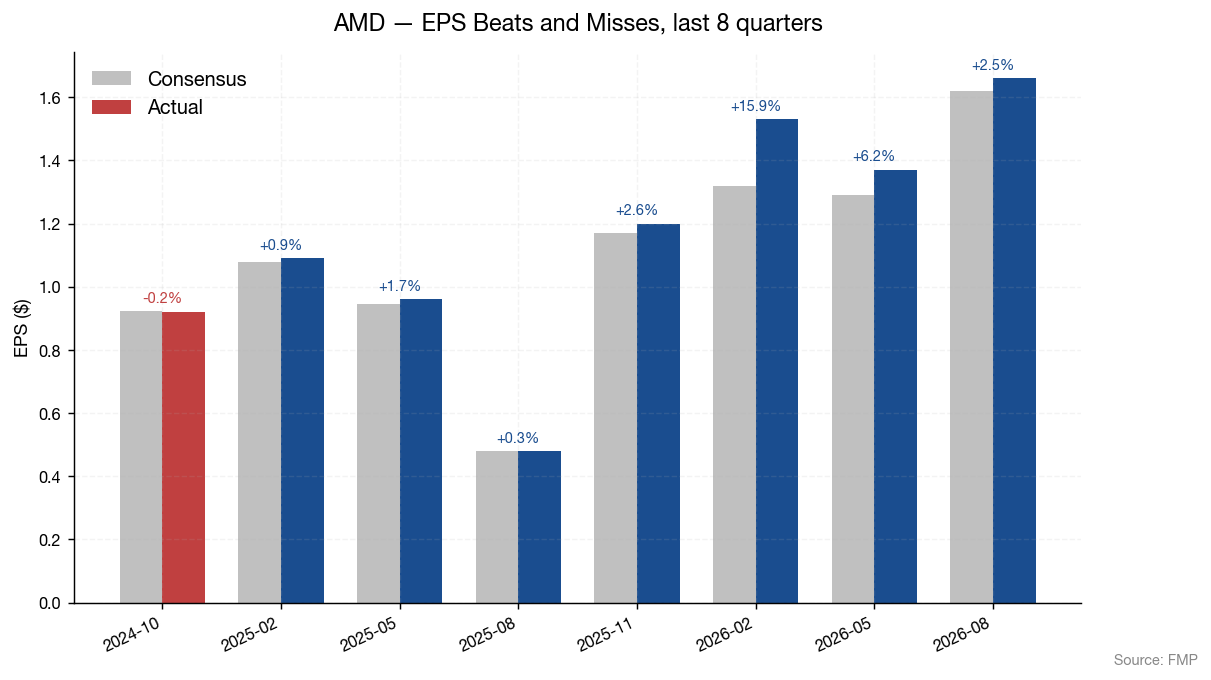
The latest print is the caution flag inside a strong record. Q2 adjusted EPS of $1.66 against $1.62 was a 2.5% surprise, the smallest of the last four quarters, after 6.2%, 15.9% and 2.6%. Guidance is being met rather than overwhelmed.
The assumption most likely to be wrong is the even drawdown. Meta's and Anthropic's commitments are ceilings written as "up to," so a slower 2028 is the likelier error, pushing $118.2B further below consensus.
What Would Change My Mind
The cleanest falsification lands on 3 November 2026 with the Q3 FY2026 print, where consensus sits at $1.90 of adjusted EPS. Su guided initial Helios shipments to begin "later this quarter." If that print shows no Helios revenue in the data center line, and no first-tranche OpenAI warrant vesting in the 10-Q, the 3 gigawatts anchoring 2027 have slipped.
The second observable is the Q4 FY2026 report in late January or early February 2027, the first that can reveal realized revenue per gigawatt. At $10B, 2028 EPS drops to $20.22, which the stock currently trades at 30 times.
Takeaway
Building the 14 contracted gigawatts from the bottom up, at management's own midpoint, produces $118.2B of 2028 revenue and $21.93 of adjusted EPS, about 4% under where the Street sits. That is what 27.7 times forward earnings buys: a book consensus has fully reflected. The upside lives in Microsoft, Oracle, sovereign and mid-scale volume no published model carries, in a realized price above $15B per gigawatt, and in a drawdown that front-loads. Those three are the reason to own it.
Sources
- AMD Q2 FY2026 earnings call, 4 August 2026 (Su, Hu, Muse, Arya)
- AMD Form 10-K FY2025, Items 1, 1A and 7, filed 4 February 2026
- AMD/OpenAI, 6 October 2025; NVIDIA/OpenAI letter of intent, 22 September 2025
- AMD newsroom on Meta, 24 February 2026; AMD and CNBC on Anthropic, 22 July 2026
- Oracle press release, 14 October 2025; AMD Financial Analyst Day, 11 November 2025
- Mercury Research via The Register, 21 August 2026
- TrendForce CoWoS notes, 15 June and 14 September 2026
- siliconanalysts foundry allocation status, Q1 2026
- Citi (Atif Malik) via Invezz and Barchart, 12 June 2026
- Melius via Investing.com and Bernstein via TheStreet, 2026
- Company filings, reported results, analyst consensus and market price data
- Full working, including the gigawatt-to-EPS walk:
research/2026-09-21_AMD.md
Research, not a recommendation. Figures are sourced as cited and were current at publication; nothing here is personalized investment advice.