Oct 10, 2026 · Atlassian Corporation (TEAM)
profitmonk
Summary
- Atlassian guides FY27 revenue up 13%, yet its Cloud business grew 31% in the June quarter. Retiring the self-hosted Data Center product explains most of the gap, and the remaining lines are guided to grow about 25%.
- Over 90% of FY26 revenue came from existing customers, and net revenue retention above 120% means that base spends at least a fifth more each year.
- My FY28 revenue build of $8.63B lands within 0.8% of the $8.56B consensus, so I have no edge on the top line.
- My FY28 adjusted EPS of $6.87 beats the $6.68 consensus only if buybacks keep shrinking the share count about 4% a year, which gets harder at today's price. On today's share count the same build gives $6.33, below the Street.
- At 31 times FY28 consensus earnings, Atlassian costs more than Microsoft does on profits already reported, so I call the stock fairly priced. Margin under AI inference cost decides it: a 20% operating margin in place of the guided 25% takes FY28 EPS to $5.06 on today's share count.
A 13% Guide, a 31% Cloud Business, and a Fair Price
Atlassian has guided to revenue growth of about 13% in FY27, which reads like a stall, yet its Cloud business grew 31% in the June quarter. Both numbers are true, and the gap between them is the accounting of a product being retired. I think the stock is fairly priced, and any upside from here depends more on margins and buybacks than on revenue.
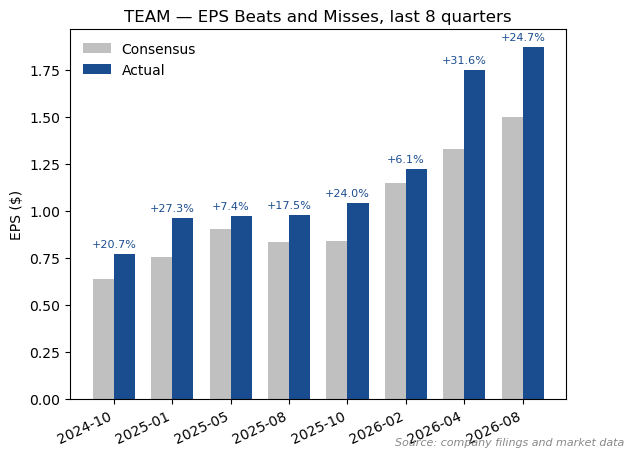
The June quarter, reported on 6 August, was the eighth in a row in which adjusted EPS beat consensus, at $1.87 against $1.50 expected. I use adjusted, or non-GAAP, figures throughout because the Street's forecasts are built on them.
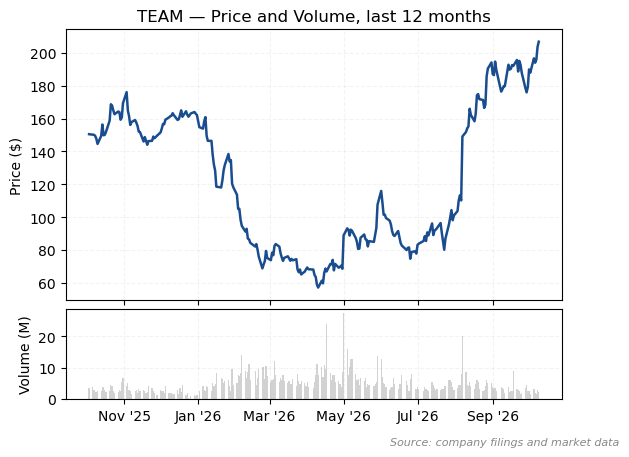
The more telling signal came that afternoon, when co-founder and chief executive Mike Cannon-Brookes said he intended to buy up to $250M of Class A stock in the open market under a trading plan. It stays an intention until Form 4 filings show him buying, but the market did not wait. The Nightly reported the stock rose as much as 39% in New York, and Bloomberg's headline read "Atlassian Shares Surge as Revenue Jump Douses AI Fears."
A Sydney Software Company Now Headquartered in San Francisco
Atlassian sells the software teams use to plan work, record what they know and run IT help desks. Jira tracks work, Confluence is the shared wiki and Jira Service Management handles IT tickets. Rovo, the AI layer on top, searches, chats and runs agents on a customer's own data, drawing on what the FY26 annual report calls the Teamwork Graph, a "unified data layer that connects contextualized teamwork data."
Mike Cannon-Brookes and Scott Farquhar founded the company in Sydney in 2002, and it is now headquartered in San Francisco. It has more than 350,000 customers and none accounts for more than 5% of revenue, so no single account can sink it.
At $206.79 a share Atlassian is worth about $54B, just under its 52-week high. Its two share classes concentrate voting power with the co-founders, so an outside investor gets the economics with little say over how the company is run.
Three Deployment Lines, and Cloud Is Now Two Thirds of Revenue
Atlassian reports revenue by how a customer runs the software, and that split shows where the business is heading. Cloud, the subscription Atlassian hosts, was 67% of FY26 revenue. Data Center is the version large customers run on their own servers, and Marketplace covers the rest.
| Line | FY26 | FY25 | Growth |
|---|---|---|---|
| Cloud | $4.41B | $3.45B | 28% |
| Data Center | $1.83B | $1.47B | 25% |
| Marketplace and other | $331M | $301M | 10% |
| Total | $6.57B | $5.22B | 26% |
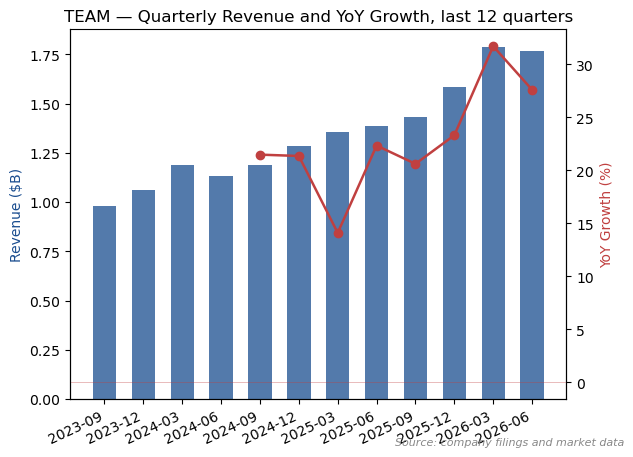
Cloud's 28% for the year had reached 31% by the June quarter. Management credits more seats, cross-selling into product bundles it calls Collections, price increases and migrations from Data Center.
The Data Center row looks odd for a product Atlassian said in September 2025 it would retire. Customers bought ahead before the door closed, and management attributes the growth to "greater upfront term license revenue recognition and pull-forward of customer purchasing from future periods."
Gross margin still rose to 85% from 83%, even though hosting fees added $87M to cost of revenue, a line I return to under inference.
The Company Is Retiring a Product That Still Grew 25%
Two changes since September 2025 explain both the fear and the opportunity. The first was Atlassian's own decision to end Data Center under an initiative it calls Atlassian Ascend. It stopped selling the product to new customers in March 2026, and the annual report says it "will stop selling term licenses and expansions to existing customers in March 2028." End of life follows in 2029, so the largest legacy customers must move to Cloud or leave.
The second came from outside. In February 2026, ACS Information Age reported, plugins for Anthropic's Claude Cowork helped set off a selloff that took roughly $1 trillion off software stocks. The fear was that companies buy fewer seats once AI agents do the work, and TEAM fell to $56.01.
The FY27 guide seemed to prove the bears right, but the 13% is low because one line is shrinking while the others grow quickly. The shareholder letter guides Data Center sharply lower after last year's buying ahead, while Cloud keeps compounding.
| Line | FY26 | FY27 guide | Change |
|---|---|---|---|
| Cloud | $4.41B | $5.54B | +25.5% |
| Data Center | $1.83B | $1.52B | −17% |
| Marketplace and other | $331M | $372M | +12.4% |
| Total | $6.57B | $7.43B | +13% |
Strip out Data Center and the remaining lines are guided to grow about 25%, nearly twice the headline rate. The contracted book agrees. cRPO, the revenue customers have signed for and Atlassian expects to recognise within twelve months, grew 27%, and management expects total growth to pick up again in FY28.
Hiring is the macro variable, because Atlassian charges by the seat. The annual report warns that uncertainty "could cause customers to reduce the number of personnel... and decrease technology spending," while Mizuho's Gregg Moskowitz pointed on the August call to "a resurgence in developer hiring."
Two Thirds of Jira and Confluence Users Do Not Write Code
The bear case says AI will shrink the seat count, but Atlassian's data shows seats spreading into new departments. CFO James Chuong, who joined in March from the same job at LinkedIn, said roughly two thirds of Jira and Confluence users are "knowledge workers... non-software development teams, really sitting in HR, legal, finance." He added that customers on the Teamwork Collection bundle run 4 to 5 times as many paid seats per instance as those on stand-alone Jira or Confluence. Both claims are management's and unaudited, but they are the most direct answer to the seat-compression thesis I have found.
That matters because the existing base is the business. Over 90% of FY26 revenue came from accounts Atlassian already had a year earlier, and Chuong put net revenue retention, what the same customers spend this year against last, above 120%. He said the June-quarter Cloud beat came from cross-selling and seat expansion, with no help from Data Center migrations.
The room to grow inside that base is large. Cannon-Brookes told analysts that existing customers represent a $14B opportunity without any change to products or pricing. Chuong made the same point from the other end: Atlassian is inside 85% of the Fortune 500, yet those companies bring in only about 10% of revenue.
The clearest share gains are in IT service management, or ITSM, the software an IT department uses to log tickets, track equipment and handle outages. Atlassian's March-quarter letter said its Service Collection had passed $1B of annual recurring revenue, growing over 30%, and Cannon-Brookes called it the company's "largest ever quarter for competitive displacements from a major ITSM provider." He did not name the provider, so reading it as ServiceNow is my inference. The slice stays small, because two more years at that pace would give Service Collection only about 11% of the ITSM market Gartner forecasts for 2028.
AI shows up in the numbers too, though less cleanly. Atlassian says Rovo is used by over 80% of the Fortune 500 and that adopters grow ARR at more than twice the rate of non-adopters. When Canaccord's DJ Hynes asked whether the best customers simply adopt first, Cannon-Brookes replied, "I don't think it's anything to do with early adopters." He offered no data, so I treat the 2x figure as correlation.
How Atlassian charges for AI matters more than the adoption figures. Rovo has no separate price tag, and Cannon-Brookes said the Teamwork Collection carries about 10x as many Rovo credits, so customers who hit their limits upgrade. Usage-based overages are still early.
Agents from other vendors now work inside Atlassian's products, which makes Jira more central to how work gets done. Cursor, Claude and GitHub agents run inside Jira, and monthly active users of Atlassian's MCP server and command-line tool doubled in the June quarter to pass 1M. MCP, the Model Context Protocol, is an open standard that lets AI agents read from and act inside other software.
The Constraint Is Atlassian's Own Calendar
Atlassian has no factory, so its two limits are internal: the forced conversion of the Data Center base, and the cost of running AI for customers.
The Data Center pool runs to a deadline, and Chuong said migrations add "mid-to-high single digits" to Cloud growth in both FY26 and FY27. What I could not find is the price uplift a customer pays on moving to Cloud. Management has not quantified it in anything I read, so I leave it out of the model.
Inference, the computing cost of answering every AI query, shows up in hosting fees. The annual report expects FY27 gross margin to "decline slightly," citing "increases in cost of revenues to support... AI usage." When UBS's Karl Keirstead asked why Atlassian's margins held while peers' slipped, Cannon-Brookes credited a multi-year "AI gateway" that blends models to manage cost.
That leaves the margin resting on what model makers charge, and the annual report concedes those providers "may make certain models or technologies more expensive for us to use." The October partnership with OpenAI deepens one of those ties, while the Cursor, Claude and GitHub agents inside Jira spread the dependence across several suppliers.
Revenue Lands on Consensus, and the Earnings Edge Rests on Buybacks
My revenue forecast matches the Street. My earnings forecast is 2.8% higher, and only because I assume buybacks continue.
I built FY28 revenue by assuming each deployment line repeats its FY27 guided rate.
| Line | FY27 guide | FY28 assumption | FY28 |
|---|---|---|---|
| Cloud | $5.54B | +25.5% | $6.95B |
| Data Center | $1.52B | −17% | $1.26B |
| Marketplace and other | $372M | +12.4% | $418M |
| Total | $7.43B | +16.2% | $8.63B |
That total sits 0.8% above the $8.56B consensus, inside an analyst range only 3% wide, and a second route through Subscription ARR lands almost exactly on the same figure. On revenue, I agree with the Street.
FY28 revenue is mostly a bet on Cloud. At 18% Cloud growth it falls below every analyst estimate, and at 28% it sits above every one.
| Cloud growth in FY28 | Source of the rate | FY28 revenue | Against consensus |
|---|---|---|---|
| 18% | FY27 Subscription ARR guide | $8.21B | 4.1% below, under the lowest estimate |
| 25.5% | FY27 Cloud guide | $8.63B | 0.8% above |
| 28% | FY26 actual | $8.76B | 2.4% above, over the highest estimate |
Data Center barely matters for FY28, because a decline 20% worse than guided trims revenue by only about $52M. That line becomes decisive in FY29, when the product reaches end of life.
The earnings gap with the Street comes down to the share count. My bridge applies the guided 25% non-GAAP operating margin, then assumes roughly 74 cents of each dollar of operating profit reaches net income, the ratio in the June quarter. One quarter is a thin basis, and a different ratio would scale every EPS figure below in proportion.
The shareholder letter says buybacks cut the net share count by about 4% in FY26, but much of that buying happened when the stock was far lower. At today's price the same dollars retire roughly half as many shares, and the right-hand column assumes the FY26 pace holds anyway.
| Step | Today's share count | Shares shrinking 4% a year |
|---|---|---|
| FY28 revenue, base case | $8.63B | $8.63B |
| × non-GAAP operating margin, FY27 guide | 25% | 25% |
| × net income per dollar of operating profit | 0.742 | 0.742 |
| ÷ diluted shares | 252.9M | 233.1M |
| = FY28 adjusted EPS | $6.33 | $6.87 |
| Against $6.68 consensus | below | 2.8% above |
At flat shares, matching consensus would take a margin of about 26.6%. I treat the shrinking-share column as my base case because it is what Atlassian has been doing, and the flat column as the outcome if buying slows sharply.
Revenue has upside if management is guiding low, as its run of beats suggests. If FY27 Cloud grows at the June-quarter rate of 31%, FY28 revenue reaches roughly $8.93B, above the highest estimate, though I keep that out of my base case.
Fairly Priced at 31 Times FY28 Earnings
Forward earnings are the only useful yardstick, because Atlassian posted a GAAP net loss for FY26 and its trailing P/E means nothing. TEAM trades at 31 times FY28 consensus EPS of $6.68.
I compared it with three real competitors at their current market multiples.
| Company | Why it is a peer | P/E, trailing | Price-to-sales |
|---|---|---|---|
| ServiceNow | direct ITSM rival | 87.5 | 9.9 |
| Microsoft | bundled collaboration and DevOps rival | 29.7 | 12.0 |
| GitLab | developer platform rival to Bitbucket | loss-making | 8.8 |
| Atlassian | GAAP loss | 8.3 |
Microsoft is the only peer with a usable P/E, because GitLab loses money and ServiceNow's 87.5 is stretched. Microsoft's 29.7 is on earnings it has already reported, while Atlassian's 31 is on earnings nearly two years out, so Atlassian costs more per dollar of near-term profit. Cloud growing 31% can carry about that premium. Paying more would need the margin and buyback case to come through as well, so I call the stock fairly priced.
Price-to-sales puts all four companies side by side, and it flatters Atlassian more than it should. TEAM is 16% cheaper than ServiceNow on sales while growing Cloud faster than ServiceNow grows subscriptions, but a sales discount says little about a company that posted a GAAP net loss of $53.8M for FY26. I could not get a reliable history of Atlassian's own multiples, so I cannot say where today's sits in its range.
Cash flow is where the bear case is strongest. Free cash flow gives a 2.4% yield on market value, but stock-based compensation ran at 24% of revenue, and subtracting it leaves free cash flow at negative $286M. That is the cleanest bear number in the file, and I take it seriously.
The Street is already positioned for the good case. Of 33 analysts covering the stock on 1 October, 27 rate it a buy or strong buy and none a sell. Cloud holding near 25% and the margin guide surviving the AI build are largely in the price, which leaves little upside unless one of them beats.
ServiceNow Is the Incumbent, and Linear Is the Startup Closing In
Atlassian defends two flanks: ServiceNow in IT service management, and AI-native startups and general-purpose agents in planning and knowledge work. On both, its argument is context.
ServiceNow is the far larger business, but it is slowing. Its 22 July 8-K guides September-quarter subscription growth to 20.5%, while Atlassian's Service Collection grows above 30%.
Linear is the startup threat in Jira's core market. Press coverage put its June 2025 Series C at a $1.25B valuation, and it ships a product called Linear for Agents. Bloomberry, which tracks software adoption across company websites, counted Linear adding 1,351 companies from February to April 2026, against 1,524 for Jira. The data is unaudited and counts logos with no weight for dollars, but it suggests the next generation of software teams is not picking Jira by default.
Microsoft bundles GitHub, Azure DevOps, Teams and Planner into accounts it already holds. Anthropic and OpenAI are both threats and partners, because Claude agents run inside Jira and OpenAI models power Rovo.
Atlassian's defence is the data it already holds. The shareholder letter says the Teamwork Graph spans more than 200B objects and connections, and Cannon-Brookes argues that organizations "will hire that intelligence by the token. A context... cannot be hired." He said customers cite AI and the Teamwork Graph as "one of the top 2 reasons" to upgrade.
BofA's Koji Ikeda asked whether the Graph is "a moat versus potentially becoming a feature." Cannon-Brookes answered that "most organizations will have 3 to 5 large-scale knowledge graphs, and we intend to be 1 of those 3." I read that as an honest concession that Atlassian is aiming to be one of a few graphs inside each customer.
Atlassian's Own Risk Factors Put AI Ahead of the Migration
The strongest case against the stock comes from the company itself. The third risk factor in the FY26 annual report reads: "Our AI offerings and investments may not be successful, which could adversely affect our business or financial results." The move to Cloud comes only fourth, so management ranks AI execution ahead of the Data Center migration.
The report also concedes the seat question: "It is possible that an increased prevalence of AI may impact the work practices of software teams, IT operations and support teams, leadership, and business teams." Its fifth risk factor warns that "any decline in our customer retention or expansion could harm our future results," which carries real weight when over 90% of revenue comes from existing accounts.
Analysts on the call raised what management left out. The FY27 Subscription ARR guide of 18% is down from 23%, and Wolfe's Alex Zukin said it "implies roughly flat organic net new ARR in fiscal '27." Chuong put about a point of the step-down to lapping the DX acquisition and part to "prudence in that second half."
The assumption most likely to be wrong is the guided margin, and AI inference is the named threat. At a 20% margin on today's share count, FY28 earnings fall to $5.06 a share. Gross margin would show the strain first, and so far the evidence is mild, because the FY27 guide trims it by only half a point in a year when Rovo usage is compounding.
Positioning is the other risk. The Motley Fool reported that the stock rose 92% in August alone, and Benzinga commentary that month attributed part of the move to short covering. A stock that has run this far has less room for a soft quarter.
What I Am Watching
Atlassian reports its fiscal first quarter on 5 November. Cloud growth above 28% would support the bull row in my table, while a sustained slide toward 20% would break the thesis, because my revenue build would then fall below every analyst's estimate. I will also watch GAAP operating margin against guidance, and Form 4 filings for any purchases by Cannon-Brookes.
Takeaway
Atlassian's 13% revenue guide is the sound of a product being retired, and a Cloud business growing 31% is what remains. My revenue build lands on consensus, so I am not betting against the Street's top line. My bet is that the guided margin holds through the AI build and that a shrinking share count turns it into earnings above the Street's, though that pace of buying gets harder at today's price. The stock is fairly priced, and the margin line in each quarterly report will settle the argument.
Sources
- Atlassian Q4 FY26 shareholder letter and earnings release, 6 August 2026
- Atlassian Q4 FY26 earnings call, 6 August 2026 (Mike Cannon-Brookes, James Chuong, with questions from DJ Hynes of Canaccord, Koji Ikeda of BofA, Karl Keirstead of UBS, Alex Zukin of Wolfe and Gregg Moskowitz of Mizuho)
- Atlassian Form 10-K for FY26, Items 1, 1A and 7, filed 14 August 2026
- Atlassian Q3 FY26 shareholder letter and call, 30 April 2026
- Atlassian Form 8-K on the CEO share purchase plan, August 2026, and on the CFO appointment, 18 February 2026
- Business Wire and Computer Weekly on Team '26 Europe and AMP, 7 October 2026
- OpenAI on the expanded Atlassian partnership, 6 October 2026
- Bloomberg, "Atlassian Shares Surge as Revenue Jump Douses AI Fears," 6 August 2026
- The Nightly and Capital Brief on the 6 August share move and CEO purchase, 6 and 7 August 2026
- The Motley Fool on FY28 re-acceleration and the 2029 end of life, 9 August 2026, and on the August move, 5 September 2026
- ACS Information Age and NBC News on the February 2026 software selloff
- ServiceNow Q2 2026 Form 8-K, 22 July 2026
- Gartner ITSM market forecast for 2028
- Bloomberry new-company adoption tracking for Jira and Linear, updated 4 May 2026
- Press coverage of Linear's Series C, June 2025
- Seeking Alpha coverage of Atlassian's 2024 investor day
- MarketBeat on analyst price target changes, September 2026
- Benzinga commentary on the August 2026 move
- Company filings, reported results, analyst consensus and market price data
- Full working, including the three-line revenue build, the ARR cross-check, the EPS bridge and the sensitivities:
research/2026-10-10_TEAM.md
Research, not a recommendation. Figures are sourced as cited and were current at publication; nothing here is personalized investment advice.