AI Booked 110 Gigawatts of Gas Turbines. The Factories Build 65 a Year.
Jul 15, 2026 · AI Data-Center Power Infrastructure Market profitmonk
Summary
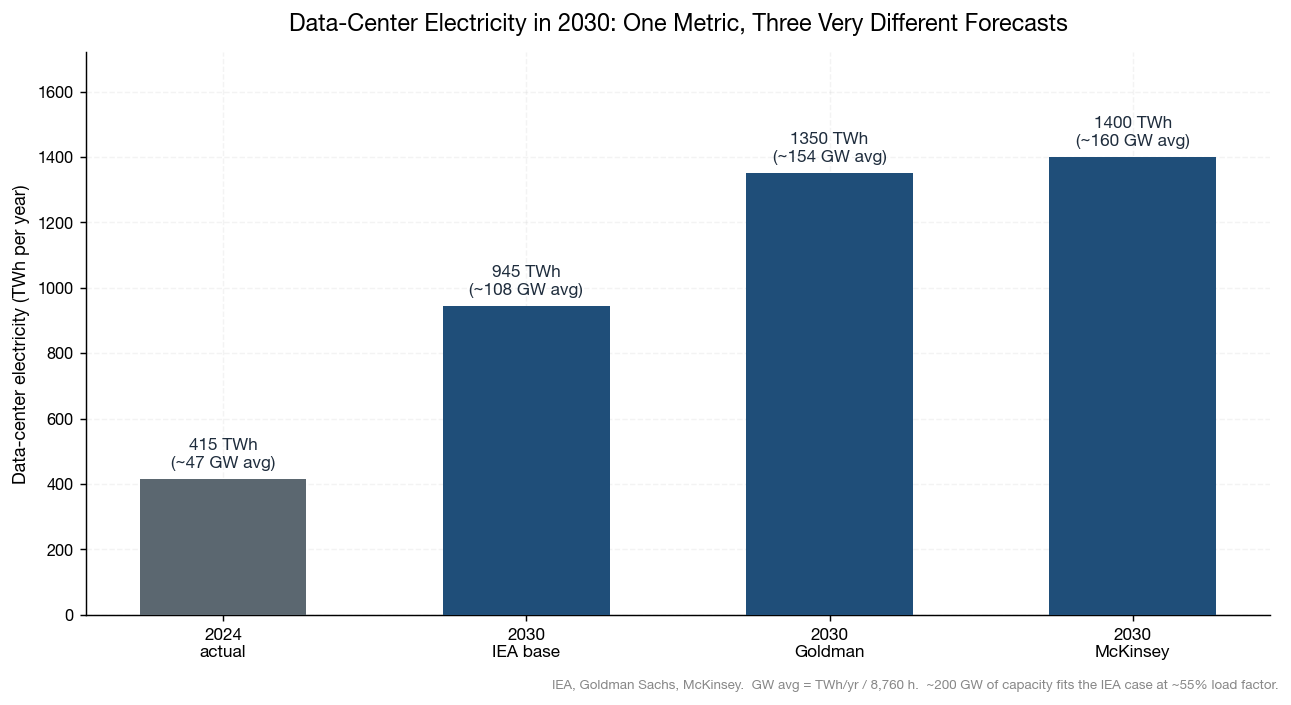
- Global data-center electricity demand is set to at least double this decade, from about 415 terawatt-hours in 2024 to somewhere between the IEA's conservative 945 and Goldman's and McKinsey's roughly 1,350 to 1,400 by 2030, and in the United States roughly 60% of the increase is expected to be met by natural gas per Goldman Sachs, which turns an AI story into a gas-turbine and grid story.
- Orders for heavy-duty gas turbines reached roughly 110 gigawatts by the end of 2025 against an industry that can build only 60 to 70 gigawatts a year per Wood Mackenzie, so a turbine ordered today delivers around 2031.
- GE Vernova alone holds about 100 gigawatts of gas backlog and slot reservations and expects to be sold out through 2030 by the end of this year, and the three-maker group of GE Vernova, Siemens Energy, and Mitsubishi controls more than 70% of heavy-duty capacity.
- The scarcity is showing up in price: gas-turbine prices are up 195% versus 2019 and heading toward roughly $600 per kilowatt per Wood Mackenzie, while large power transformers now carry lead times near 128 weeks.
- Grid investment needs to climb from about $400 billion a year toward more than $600 billion a year by 2030 per the IEA, and the public names most levered to the conclusion are GE Vernova, Siemens Energy, and Mitsubishi in turbines, plus Eaton, Quanta, Hubbell, Hitachi, and Vertiv across the grid and the data-center power chain.
The Question: Can the World Build the Power That AI Just Ordered?
There is a claim making the rounds that I wanted to test from the ground up, because if it is true it reprices a whole set of companies, and if it is false it is one of the great head-fakes of this cycle. The claim is that the artificial-intelligence build-out has ordered more electrical generating capacity than the world's factories can physically build for the rest of the decade, and that the equipment makers therefore hold pricing power they have not had in forty years. GE Vernova's chief executive Scott Strazik said on the company's first-quarter 2026 call that he expects his gas-turbine reservation book to be sold out through 2030 by the end of this year. That is the kind of sentence that either describes a genuine shortage or describes a bubble in reservations that never convert. This article builds the supply and demand for the AI power market from the bottom up, in gigawatts, to see which one it is.
I am going to keep the discipline explicit throughout. Every hard number here is either sourced to a named forecaster or filing, or it is my own estimate with the basis stated. Where the whole conclusion turns on an assumption, I will say so. The market I am sizing is the equipment needed to add dispatchable generation and grid capacity for data-center load, and it has two constrained spines. The first is heavy-duty gas turbines, which are the machines utilities buy when they need power that runs on demand rather than when the wind blows. The second is grid equipment, chiefly the large power transformers that step voltage up and down between the plant and the data center. Both are sold out, and understanding why is the whole game.
The Supply Side: Three Companies, Sold Out to 2030
The gas-turbine business is a tight oligopoly, which is the first reason the shortage has teeth. GE Vernova, Siemens Energy, and Mitsubishi Power together hold more than 70% of heavy-duty production capacity, per GMInsights' 2026 market study. Market-share claims below that headline get slippery because the firms measure different things. Mitsubishi led on megawatts ordered at roughly 36%, and took 56% of the most advanced G, H, and J class machines, per McCoy Power Reports data cited in a March 2024 Mitsubishi release. GE Vernova led on revenue at more than 18.5% in 2025 per GMInsights. Those are different denominators and I am not going to pretend they reconcile into a clean three-way split, because a tier-one source for that split does not exist that I could find. The point that matters is that three Western companies control the supply, and none of them can conjure capacity quickly.
The backlog numbers are where the story stops being abstract. GE Vernova reported roughly 100 gigawatts of combined gas backlog and slot reservations in the first quarter of 2026, made up of about 44 gigawatts of firm backlog and 56 gigawatts of reservations, up from 83 gigawatts at the end of 2025, per Power Engineering's April 2026 coverage. The company is targeting at least 110 gigawatts by the end of this year, and it reported only about 10 gigawatts of 2029 and 2030 delivery slots still open as of the first quarter. Its total remaining performance obligation, the accounting term for contracted revenue not yet delivered, stood at $163 billion. Siemens Energy's gas business is booked out to fiscal 2028, with more than a quarter of that gas backlog tied specifically to data centers per S&P Global reporting. Mitsubishi's large-frame orders rose to 35 units in fiscal 2025 and it described its ten-year forecast for machines above 100 megawatts as having practically doubled on AI demand, per its May 2026 earnings.
Now hold those order books against what the factories can actually produce. Global heavy-duty gas-turbine output runs at roughly 60 to 70 gigawatts a year, against the roughly 110 gigawatts booked by the end of 2025, per Wood Mackenzie's April 2026 analysis, and the lines are running near 90% utilization. The makers are expanding, but slowly and in aggregate modestly. GE Vernova is lifting its heavy-duty capacity to 20 gigawatts annualized by the third quarter of 2026 and 24 gigawatts by 2028, backed by roughly $600 million of US investment inside a broader $9 billion capex and research program through 2028. Siemens is adding about $1 billion of capacity, and Mitsubishi is roughly doubling its capacity by around fiscal 2030 with about $618 million of investment per Nikkei. The catch is the one EPRI's Bobby Noble flagged to Utility Dive in early 2026: any single maker doubling its own line only lifts total industry output by something like 15% to 40%, because the binding constraint is not the OEM's factory footprint, it is the supply of skilled labor and specialized parts underneath it.
The grid side rhymes. Large power transformers now carry lead times of roughly 128 weeks, and generator step-up units roughly 144 weeks, both of which have doubled since 2021, per Wood Mackenzie's mid-2025 survey, and Hitachi Energy quotes more than 30 months. The United States ran an estimated 30% deficit in large power transformers in 2025, narrowing toward 5% by 2030 as capacity comes on, with about 80% of supply imported. So on both spines, the equipment to power AI is capacity-rationed, and the rationing runs years deep.
The Demand Side: Somewhere Between a Doubling and a Tripling by 2030
The demand build starts with electricity and then converts to the generating and grid capacity that has to be built to serve it, and the honest first thing to say is that the forecasters do not agree on the size. The IEA's April 2025 Energy and AI report put global data-center consumption at about 415 terawatt-hours in 2024, roughly 1.5% of world electricity, and projected about 945 terawatt-hours by 2030 in its base case, a doubling. Goldman Sachs and McKinsey both model materially more, roughly 1,350 and 1,400 terawatt-hours respectively, closer to a tripling. That is a wide spread for a six-year forecast, and I am going to carry the range rather than quietly pick the low end, because the equipment demand looks very different at 945 than at 1,400.
Translating those energy numbers into power is what makes them concrete, and it also exposes a tension the headlines tend to skate past. A terawatt-hour is a billion kilowatt-hours, and dividing annual consumption by the 8,760 hours in a year gives average power draw. The 2024 figure of 415 terawatt-hours works out to about 47 gigawatts of average load, and the world had roughly 122 gigawatts of installed data-center capacity that year per Synergy Research, which implies the global fleet ran at around a 40% load factor once you blend hyperscale with older enterprise sites. JLL and McKinsey both see installed capacity nearly doubling to about 200 gigawatts by 2030. Here is the catch. Two hundred gigawatts of capacity produces about 945 terawatt-hours only if the fleet-wide load factor climbs to roughly 55%, and it produces 1,400 terawatt-hours only if that load factor reaches about 80%, which would mean nearly the entire global fleet running like a maxed-out AI training cluster. The IEA number reconciles cleanly with the capacity everyone forecasts. The McKinsey number requires either far more capacity than 200 gigawatts or a utilization the industry has never sustained fleet-wide. I read the more defensible base case as landing in the lower half of the range, with the upside real but contingent on the buildout outrunning even today's plans.
The United States is where the strain concentrates, and where the equipment gets ordered. Lawrence Berkeley National Laboratory's December 2024 report put US data centers at 176 terawatt-hours, about 4.4% of national power, in 2023, rising to a range of 325 to 580 terawatt-hours, or 6.7% to 12%, by 2028, and EPRI's updated work puts them at 9% to 17% of US power by 2030. Grid Strategies raised its five-year US load-growth forecast to 128 gigawatts in December 2024, roughly five times what it published in 2022, with data centers the largest single driver. You can see the scarcity in the wholesale market, where PJM, the largest US grid operator, cleared its capacity auction at or near the roughly $329 to $333 per megawatt-day cap for three auctions running, and ERCOT projects its Texas peak reaching about 139 gigawatts by 2030.
One more distinction matters more than any single forecast, because it is where the bull and bear cases actually split: the difference between what is announced and what is being built. Global data-center capacity under active construction was roughly 30 gigawatts at the end of 2025 per BloombergNEF and DatacenterDynamics, itself more than double the year before. The announced pipeline, by contrast, runs to about 190 gigawatts of large facilities proposed since 2024, and the same trackers warn that 30% to 50% of it is unlikely to energize, held back by power, permitting, and interconnection queues. The buildout that feels enormous is enormous in announcements and much smaller in poured concrete, and the gap between the two is the single biggest question hanging over every demand number in this article.
The step that turns all of this into a gas-turbine thesis is the fuel mix, and here the geography matters. Goldman Sachs estimated that roughly 60% of the increase in United States data-center demand will be met by natural gas, with about 40% from renewables and a little nuclear, and Wood Mackenzie sees roughly 63 gigawatts of new US gas capacity planned between 2026 and 2030. That 60% is a US figure, and the global gas share is lower, because China, which the IEA expects to supply a large slice of the growth, leans on coal and renewables rather than US-style gas. Taking the US demand increase and Goldman's gas share, my rough build gets to on the order of 60 to 90 gigawatts of new US gas generation needed this decade to serve data centers, before the reshoring and electrification load growing alongside them. I am flagging that as my estimate on their inputs, not a published number, and its use is as a cross-check: it lands in the same neighborhood as, and helps explain, the roughly 110 gigawatts of gas turbines already in the global order book, which also serves load well beyond US data centers.
The Balance: 110 Gigawatts of Orders Against 65 of Factory
Here is the pivot of the whole model. On the supply side, the industry builds 60 to 70 gigawatts of heavy-duty gas turbines a year and is running flat out. On the demand side, roughly 110 gigawatts sat in the order book at the end of 2025, and the demand build above says the underlying electricity need justifies that order flow rather than exceeding it. The arithmetic of that mismatch is why a turbine ordered today is quoted for delivery around 2031, per Utility Dive's March 2026 reporting. This is the same shape as the memory and advanced-packaging shortages driving the chip side of AI, where demand arrives faster than fabrication capacity can expand, and the supplier captures the gap as price and backlog rather than as lost sales.
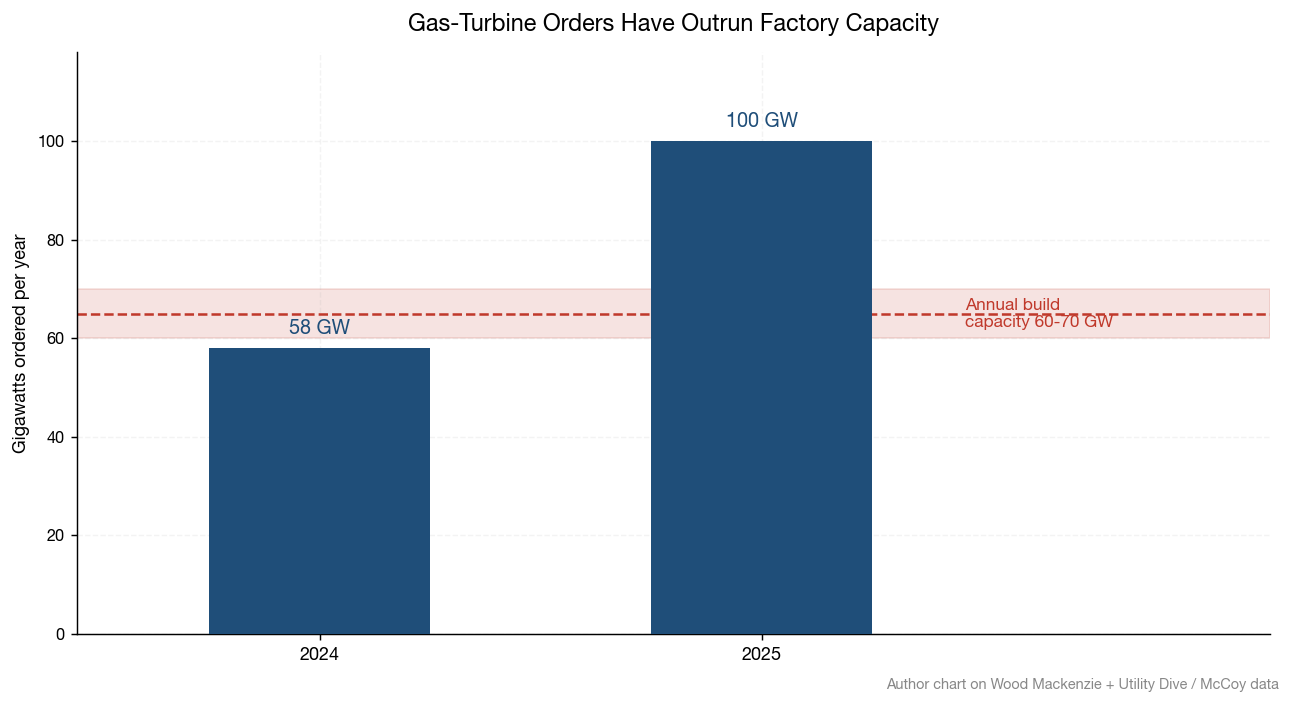
I want to be honest that the 110-versus-65 figure is the single most important number in this article, so it deserves its cross-check. Wood Mackenzie is the direct source for both sides of it in its April 2026 analysis. The demand side that justifies it is corroborated independently by the IEA's doubling of data-center load and by McKinsey's 171-to-219-gigawatt capacity path, two forecasters with no stake in Wood Mackenzie's turbine numbers. When the equipment analyst and the energy agencies arrive at a shortage from different directions, the balance is more likely real than an artifact of one model. The place it could still break is not the arithmetic but whether the orders themselves are genuine, which I take apart in the counter-model below.
The Price and the Size: A $600-a-Kilowatt Turbine and a $600-Billion Grid
Scarcity that is real shows up in price, and it has. Gas-turbine prices are up 195% versus 2019 and heading toward roughly $600 per kilowatt by the end of 2027, per Wood Mackenzie, and GE Vernova has said its new-order pricing runs 10 to 20 points above where it sat in the fourth quarter of 2025. The all-in cost to build a combined-cycle gas plant reached about $2,157 per kilowatt in 2025, up from under $1,500 in 2023 per project data compiled by TechCrunch. On the grid, large power transformer prices are up roughly 75% since 2019, driven substantially by grain-oriented electrical steel, the specialized transformer-core material, roughly doubling in price since early 2020. I will note the one real dissent in the data: Rystad Energy argued in May 2026 that transformer prices and lead times are stagnating rather than climbing further, which is a genuine signal that some of the grid scarcity may be nearer its peak than the turbine scarcity.
Sizing the market in dollars is where the sourcing gets uneven, and I will not pretend otherwise. The pure gas-turbine equipment market is put at only about $20 billion to $24 billion in 2025 rising to roughly $29 billion to $30 billion by 2030 by second-tier research firms like Mordor Intelligence, and I could not find a tier-one gas-turbine dollar TAM. The more meaningful demand metric there is order volume, roughly 100 gigawatts and 846 units ordered in 2025 against 58 gigawatts in 2024 per Utility Dive. The grid equipment TAM is far better anchored. The IEA's June 2025 World Energy Investment report put global grid investment at about $400 billion a year and said it needs to nearly double to more than $600 billion a year by 2030, a number corroborated by BloombergNEF, which sees grid capex rising from about $470 billion in 2025 toward a $483 billion to $811 billion range by 2030, and by Rystad at more than $650 billion in 2026. Inside that, MarketsandMarkets sizes power transformers at roughly $30 billion in 2025 growing to about $42 billion by 2030, and switchgear above $100 billion. Wood Mackenzie sizes the US data-center-specific electrical-equipment market alone growing from about $20 billion to $65 billion by 2030.
The serviceable slice, the SAM, is narrower than the TAM in both spines. On turbines, the three Western makers hold more than 70% of ex-China heavy-duty capacity, so the market they can actually serve is the large majority of the roughly $20 billion to $30 billion equipment TAM and the roughly 100-gigawatt order book, once you strip out Chinese-domestic volume that never reaches them. I could not source a clean China carve-out, so I am stating that qualitatively rather than to a false decimal. On the grid, the serviceable market is more fragmented, split across Hitachi Energy, Siemens Energy, GE Vernova through its Prolec joint venture, Eaton, and Schneider, with no single player above roughly 20% to 30% by my read of the revenue disclosures, and no tier-one share table to cite.
Who Is Levered: The Turbine Three and the Grid Pick-and-Shovel Names
The cleanest way to own the turbine conclusion is the three makers. GE Vernova is the purest expression, with its $163 billion backlog and roughly 20 gigawatts, about a fifth of its gas book, tied to data centers, and the stock has run roughly 333% since it was spun out of GE in April 2024. Siemens Energy carries a record backlog above €150 billion across gas and grid and has been the turnaround story of the group. Mitsubishi Heavy is the megawatt-share leader in large machines and carries a defense tailwind alongside the energy backlog, which makes it the most diversified of the three. If the shortage is real and pricing holds, these are the direct beneficiaries.
The grid and data-center power chain gives a second, broader set of names, and this is where a reader who thinks the turbine trade is too crowded can still express the thesis. Vertiv is the most direct data-center power and cooling pure-play, with a $12.45 billion backlog up 81%. Eaton draws about 21% of sales from data centers and reported data-center orders up 240% year over year. Quanta Services is the grid construction pick-and-shovel with a $48.5 billion backlog, and Hubbell makes the utility transformers and grid components, with data-center sales up 40%. Hitachi is the only listed route to Hitachi Energy, the largest transformer and high-voltage player. Smaller names like Powell Industries, nVent, and Prysmian round out the switchgear and cabling exposure. The same list is also the short list if the demand proves hollow, and the market has already shown how fast that can turn: Eaton fell roughly 15% in a single January 2025 session on the DeepSeek efficiency scare. GE Vernova and Siemens Energy carry the most multiple-compression risk precisely because the most AI-power optimism is priced into them.
The Counter-Model: Is the Order Book Even Real?
A model that only argues its own side is a pitch, so here is the strongest case that this shortage evaporates. The most serious threat is not efficiency and it is not substitution, it is that the order book is partly fictional. The Financial Times documented phantom data centers, where the same project is shopped to multiple utilities to lock up interconnection, inflating the queue. Camus Energy's analysis found five to ten times more interconnection requests than data centers that actually get built, Exelon has said only about 22% of its 65-gigawatt pipeline is likely real, and in December 2025 the FERC ordered PJM to reform co-location rules partly to address double-counting. If a meaningful slice of the 110-gigawatt turbine book is speculative reservations against load that never energizes, the shortage unwinds and the pricing power with it. That is the assumption the entire thesis leans on, and it is the one I would watch hardest.
The other three bear arguments are real but weaker. Efficiency is the loudest: Nvidia claims up to 50 times the token throughput per megawatt on Blackwell Ultra and roughly 10 times the inference performance per watt on Rubin. But per-chip power draw is rising, not falling, from about 700 watts on the H200 to about 1,200 watts on the B200, and peer-reviewed work on AI rebound effects finds efficiency gains can be more than fully consumed by higher usage, the Jevons paradox, so efficiency cutting total power demand is not well supported. The capex-air-pocket case is more serious as a demand risk than an efficiency one: Michael Burry has alleged roughly $176 billion of understated hyperscaler depreciation across 2026 to 2028, an MIT NANDA study found 95% of enterprise generative-AI pilots showing no profit-and-loss impact, and Goldman's own Jim Covello has questioned whether the spend earns its return. If hyperscaler capex rolls over, the order book softens regardless of physics. Finally, substitution through nuclear and small modular reactors is real, with named deals from Microsoft, Amazon, Google, and Oklo, but nearly all of that capacity lands in 2028 and later and much of it is non-binding, so through the front half of this window gas remains the bridge fuel. The one bull-case comfort in the bear file is that capacity catching up should have shown as shorter lead times or price cuts by now, and instead lead times have lengthened toward as long as seven years with no evidence of discounting.
Takeaway
The number to remember is 110 against 65: roughly 110 gigawatts of gas turbines ordered against an industry that builds 60 to 70 a year, sitting on top of a data-center electricity demand that at least doubles by 2030 and may come closer to tripling. That imbalance is why three turbine makers and a handful of grid suppliers hold pricing power the sector has not seen in decades, and it is corroborated from both the equipment side and the energy-agency side, which is what makes it more than one analyst's model. The load-bearing assumption is not the arithmetic, it is whether the order book reflects real end-load or double-counted reservations, and the phantom-data-center evidence is the reason to hold the thesis with humility rather than conviction. The signpost to watch is concrete and near: whether GE Vernova actually reports its reservation book sold out through 2030 by the end of this year, as its chief executive has guided, or whether the reservations start to cancel first.
Sources
- IEA: Energy and AI (April 2025)
- IEA: World Energy Investment 2025
- LBNL: 2024 United States Data Center Energy Usage Report
- Grid Strategies: National Load Growth Report 2024
- Wood Mackenzie: gas turbine and grid analysis (2025-2026)
- GE Vernova Q1 2026 results
- Utility Dive: gas turbine backlog and lead-time coverage (2026)
- FERC: PJM co-location order (December 2025)
Research, not a recommendation. Figures are sourced as cited and were current at publication; nothing here is personalized investment advice.