AMD Just Locked In 12 Gigawatts of Committed AI Demand. Q2 Prints in 22 Days.
Jul 13, 2026 · Advanced Micro Devices, Inc. (AMD) profitmonk
Summary
- AMD entered July with two multi-year deployment commitments totaling 12 gigawatts of GPU capacity (Meta's 6GW MI450 deal announced February 24, 2026, plus OpenAI's 6GW deal announced October 2025), a combined value that Introl estimates at more than $100 billion for Meta alone and $90 billion for OpenAI.
- Q2 2026 revenue guidance of $11.2 billion is $700 million above the analyst consensus that was in place before the guide, and represents 46% year-over-year growth at the midpoint.
- MI355X inference performance now matches Nvidia's Blackwell B200 on the Llama3-70B pre-training workload while carrying 50% more on-package memory (288 gigabytes vs. 192 gigabytes), which is the exact spec that lowers cost per inference token at hyperscaler scale.
- The binding constraint on AI hardware supply through 2026 is not chip design but TSMC's CoWoS advanced packaging line, which is sold out through mid-2026 and expanding by only 271% into 2027, meaning AMD's share of the merchant GPU market is structurally protected by capacity rationing.
- Goldman Sachs (Buy, $640 target), Stifel ($635), and Citigroup (upgrade to Buy, $575) all reset targets higher in July 2026, before the Q2 print on August 4.
Investment Thesis
The AMD story that Wall Street was pricing through 2024 and most of 2025 was a hardware-catch-up story. AMD chips were getting closer to Nvidia chips, ROCm was getting closer to CUDA, hyperscalers were curious. The story that AMD is entering the August 4 earnings print with is completely different. Two of the largest AI infrastructure buyers in the world, Meta Platforms and OpenAI, have committed to multi-generation GPU platforms totaling 12 gigawatts of capacity, with the first gigawatt of each deployment going live in the second half of 2026. That is not a curiosity purchase. That is design-win-scale multi-year procurement, the kind that changes the P&L trajectory for the rest of the decade. On top of that, TSMC's advanced-packaging bottleneck means Nvidia physically cannot serve all the demand even if it wants to, which converts AMD's "second source" narrative from a marketing line into a supply-chain reality. The question for the reader is not whether AMD is winning share. The question is how much of that winning shows up in the August 4 print, how much shows up in 2027 guidance, and whether the current valuation already reflects it. My argument is that the current setup is materially better than what the sell-side consensus was modeling as recently as May, that the demand-supply picture creates a durable multi-year revenue floor, and that Q2 is likely to be another beat-and-raise print that pulls the 2027 revisions higher.
The Demand Story: 12 Gigawatts of Named, Committed Deployment
The single most important development in the AMD narrative in the last twelve months is that hyperscaler buying commitments have moved from purchase orders to multi-year platform deals. Two announcements set the ceiling on how much AMD can grow.
On October 6, 2025, AMD and OpenAI announced a 6-gigawatt multi-generation partnership built around the MI450 GPU platform. First gigawatt of deployment capacity is scheduled to go live in 2026. OpenAI received a warrant for up to 160 million AMD shares at $0.01 each, vesting on deployment milestones through October 2030. This deal is expected to translate into approximately $90 billion in cumulative hardware revenue potential over the term.
On February 24, 2026, Meta Platforms signed an even larger commitment. The Meta agreement covers up to 6 gigawatts of custom AMD Instinct MI450 GPUs across Meta's data center fleet. Meta's warrant grants the right to acquire 160 million AMD shares (roughly 10% of the company) contingent on deployment milestones through 2030. The MI450X has a Total Board Power of approximately 2,000 watts, which implies about 3 million GPUs across the deal, and Introl estimates total value at more than $100 billion.
Oracle rounds out the near-term deployment triangle. Oracle has committed to deploy 50,000 MI450 GPUs starting in Q3 2026, which is this quarter. The Oracle GPU commitment is anchored to Oracle's contract with OpenAI to provide $60 billion per year of cloud infrastructure for five years (2027 through 2031), which is part of Oracle's broader $500 billion Stargate data center buildout.
Note the timing. Every one of these deployments starts converting to shipped revenue in the back half of 2026. Meta's first gigawatt begins deployment in H2 2026. OpenAI's first gigawatt goes live in 2026. Oracle's 50,000 GPUs begin shipping in Q3 2026. AMD's guidance for Q2 2026 revenue of $11.2 billion is real growth today, but the shape of the revenue curve tilts steeply into Q4 2026 and 2027 as these commitments actually land in the P&L.
Compare that to the demand picture the market was giving AMD credit for as recently as January 2026, when the primary bull thesis was still "AMD is winning MI325X orders opportunistically." The scale of the deployment commitments changes the math entirely. This is not opportunistic. This is the industry's largest AI buyers committing multi-year, multi-generation, warranting equity against delivery. When a customer takes an equity position tied to your delivery, they are not shopping around.
The Supply Story: TSMC's CoWoS Bottleneck Protects AMD's Share
The demand story only matters if AMD can actually build the chips it has committed to ship. Here the picture inverts an old bear argument, because the binding constraint in 2026 is not AMD's design pipeline, it is TSMC's advanced-packaging capacity, and that constraint applies to Nvidia just as much as it applies to AMD.
CoWoS, which stands for Chip-on-Wafer-on-Substrate, is TSMC's advanced packaging line that stacks a compute die alongside High Bandwidth Memory stacks on a shared silicon substrate. Every high-end AI GPU shipped in the world today goes through a CoWoS or CoWoS-equivalent line. When analysts say CoWoS is the bottleneck, they mean whoever gets more of TSMC's line time ships more accelerators.
TSMC CEO C.C. Wei confirmed in Q4 2025 guidance that CoWoS capacity remains sold out through 2025 and into 2026. Nvidia has separately confirmed that CoWoS assembly capacity is oversubscribed through at least mid-2026. TSMC is expanding CoWoS from approximately 35,000 wafers per month in late 2024 to a target of 130,000 wafers per month by late 2026, which is a 271% capacity increase. Nvidia has locked roughly 50% of the expanded run rate, or approximately 65,000 wafers per month at target, which leaves the remaining 65,000 wafers per month for all other customers. AMD is number two or three in the CoWoS allocation queue, ahead of every merchant customer that is not Nvidia.
The upstream memory picture reinforces the point. SK Hynix, which supplies roughly 50% of global HBM3E (High Bandwidth Memory generation 3, enhanced) capacity, has stated flatly that its entire 2026 HBM production is already allocated. HBM3E 12-hi stacks, the specific variant used in MI355X and B200, are effectively sold out for 2026, with prices up double digits year-over-year. Samsung and Micron are ramping alternate supply, but the overall HBM pool is fully spoken for.
You can think of the entire AI hardware supply chain as three bottleneck layers stacked on top of each other. TSMC's leading-edge wafers are the first constraint. CoWoS packaging is the second. HBM allocation is the third. In 2026, all three constraints are binding simultaneously, and the timelines to expand each layer are different. What this means practically is that hyperscalers cannot buy their way out of the constraint by paying Nvidia more money. There is not enough Nvidia to buy. AMD's structural share of the merchant AI accelerator market is protected by the physics of packaging capacity, not by superior sales execution.
On the software side, the historical bear argument was CUDA lock-in. That argument is not wrong for training workloads, but the industry mix is shifting. As of mid-January 2026, ROCm (Radeon Open Compute, AMD's parallel-computing platform equivalent to Nvidia's CUDA) is now a first-class platform in the vLLM inference ecosystem, with 93% of AMD test groups passing in daily regression maintenance. vLLM is the open-source inference engine that most non-Google, non-Meta hyperscalers standardize on for LLM serving. AMD's AITER attention kernel delivers a 15 to 20% decode throughput improvement versus standard KV-cache layouts, and FP8 KV-cache quantization reduces memory footprint by roughly 50%, which translates to longer context windows or higher concurrent user counts on the same hardware.
The Technology Proof: MI355X Ties the B200, MI400 Sets Up a Real Lead
The technical picture underneath the demand story is what separates this argument from a hype cycle. AMD is not shipping a "closing the gap" chip. It is shipping a chip that matches Nvidia's B200 on inference workloads and beats it on memory capacity.
MI355X specifications, in one paragraph the reader can hold in their head: 288 gigabytes of HBM3E memory (50% more than the B200's 192 gigabytes), 8 terabytes per second of memory bandwidth (parity with B200), and 10.1 PFLOPS of FP8 tensor throughput (FP8 is the 8-bit floating-point precision format that inference engines use to run models fast and cheap). AMD's own claim is 10% higher peak FP8 than the B200's approximately 9 PFLOPS with sparsity, though real workload results narrow that gap. In direct testing, an 8-GPU MI355X system matched an 8-GPU B200 system on the Llama3-70B pre-training FP8 workload, per AMD's disclosures. Lisa Su, at ISSCC 2026, described the achievement as matching the performance of the more expensive and more complex GB200.
The advantage that actually matters at hyperscaler scale is the extra 96 gigabytes of on-package memory. Larger memory means larger models fit on fewer GPUs, which means fewer inter-GPU communications, which means lower total cost per inference token. For a hyperscaler measuring compute in dollars per served response, this is a bigger deal than raw FLOPS parity. The B200's 192 gigabytes forces frontier models to shard across more GPUs, and every additional shard adds latency and bandwidth pressure.
The MI400 series, scheduled for 2026 launch, extends this positioning. Two SKUs: the MI455X, aimed at large-scale AI training and inference, and the MI430X, aimed at high-performance computing and sovereign AI, which includes hardware FP64 (64-bit floating-point) support. Both share 432 gigabytes of HBM4 memory, 19.6 terabytes per second of bandwidth (roughly 2.5 times MI355X), 40 PFLOPS of FP4 and 20 PFLOPS of FP8, and 300 gigabytes per second of scale-out bandwidth per GPU. HBM4 is the next-generation memory standard, offering higher stack heights and higher per-stack bandwidth than HBM3E. On paper, MI400 competes cleanly with Nvidia's Vera Rubin (Nvidia's 2027 successor to Blackwell) and re-establishes a real memory-capacity lead in the segment.
The Meta and OpenAI 6GW deals are anchored specifically to MI450, which is the platform-scale variant of the MI400 architecture. MI450X has a Total Board Power of approximately 2,000 watts per chip and is purpose-built for the rack-scale "Helios" architecture that AMD debuted alongside the OpenAI deal announcement. Helios is AMD's system-level answer to Nvidia's Blackwell rack platform, and it is not a paper design. Meta is buying it. OpenAI is buying it. Oracle is buying it.
The Competitive Vector: Why AMD Wins This Fight
Three questions define this section: why does AMD win, how does it win, and why does Nvidia not win the entire market.
Why AMD wins. AMD is now the only credible second source at frontier-model scale. Meta signed a 6GW Nvidia deal one week before signing the 6GW AMD deal. That decision was not driven by AMD being cheaper or faster. It was driven by Meta's explicit decision to diversify its GPU supply chain, because no hyperscaler will single-source $100 billion of infrastructure from one vendor. OpenAI is executing the same playbook. Oracle is executing the same playbook. Citigroup's Atif Malik captured it in July 2026: AMD is "emerging as a legit second source" in the GPU market.
How AMD wins. Two moats matter here. The first is a Total Cost of Ownership (TCO) moat in inference. MI355X's extra 96GB of memory reduces the number of GPUs needed to serve a given model at a given latency budget, which reduces the dollar cost per served token. That advantage compounds as models get larger, not smaller. The second moat is supply-chain rationing. Because TSMC's CoWoS line is capacity-constrained and Nvidia's share is capped at approximately 50% of the expanded run rate, the residual demand has to go somewhere. AMD is the only merchant supplier with the design credibility and the fab relationships to absorb it at scale.
Why Nvidia does not win everything. Nvidia holds approximately 50% of the CoWoS pipeline through late 2026, but that means the other 50% is not Nvidia. Nvidia's pricing power extracts a premium that hyperscalers are increasingly reluctant to pay when they are measuring compute in dollars per token instead of dollars per FLOP. Nvidia's software moat, CUDA, still holds for training workloads, but the industry mix is shifting toward inference where ROCm has already closed most of the gap. And in raw hardware terms, MI355X ties B200 on real workloads while offering 50% more memory. Nvidia's Vera Rubin, arriving in 2027, will re-open the performance advantage, but by then AMD will be shipping MI400 with 432GB HBM4. The two-chip race stays close through the entire decade.
Why Intel Gaudi does not win. Intel's Gaudi 3 has shipped but has not landed a comparable hyperscaler design win at scale, and Intel has not publicly announced a Gaudi 4 successor competitive with MI400 or B200. Roadmap execution has been slow, and hyperscaler procurement teams model on roadmaps.
Why Google TPU does not affect this market. Google TPU is an internal Google product. It does not ship to Meta, Oracle, or OpenAI's non-Google cloud deployments. TPU is a real product but it is not merchant supply.
The Financial Confirmation
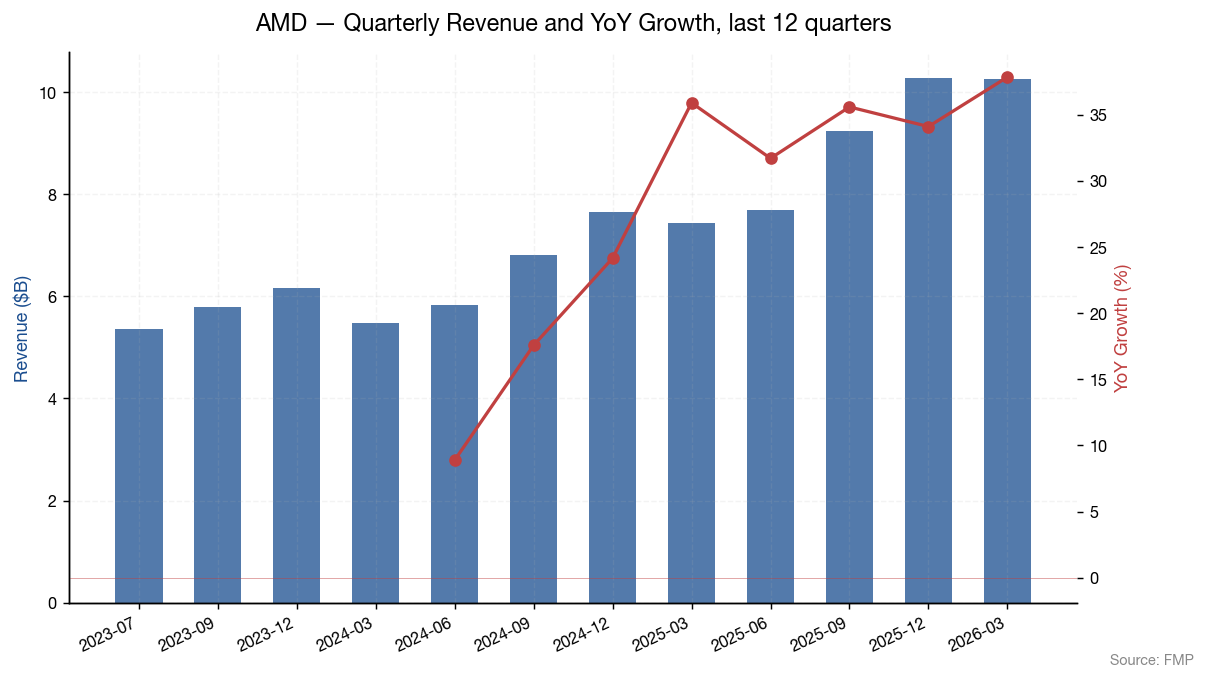
The demand and supply story is showing up in the numbers. Q1 2026 data center revenue was $5.8 billion, up 57% year-over-year from $3.67 billion, driven primarily by fifth-generation EPYC processors and MI350 series GPUs. Lisa Su characterized the print as "a clear inflection in our growth trajectory and a structural shift in our business."
Q2 2026 guidance is where the story gets interesting. AMD guided revenue of $11.2 billion plus or minus $300 million at the midpoint, representing 46% year-over-year growth and 9% sequential growth. Before AMD's guidance, the sell-side consensus was $10.53 billion. AMD guided approximately $700 million above consensus in a single quarter. Non-GAAP gross margin is guided to approximately 56%, and non-GAAP operating expenses to $3.3 billion. Server CPU revenue is expected to grow more than 70% year-over-year in Q2 alone, with management explicitly calling for robust growth continuing through 2H 2026 and into 2027.
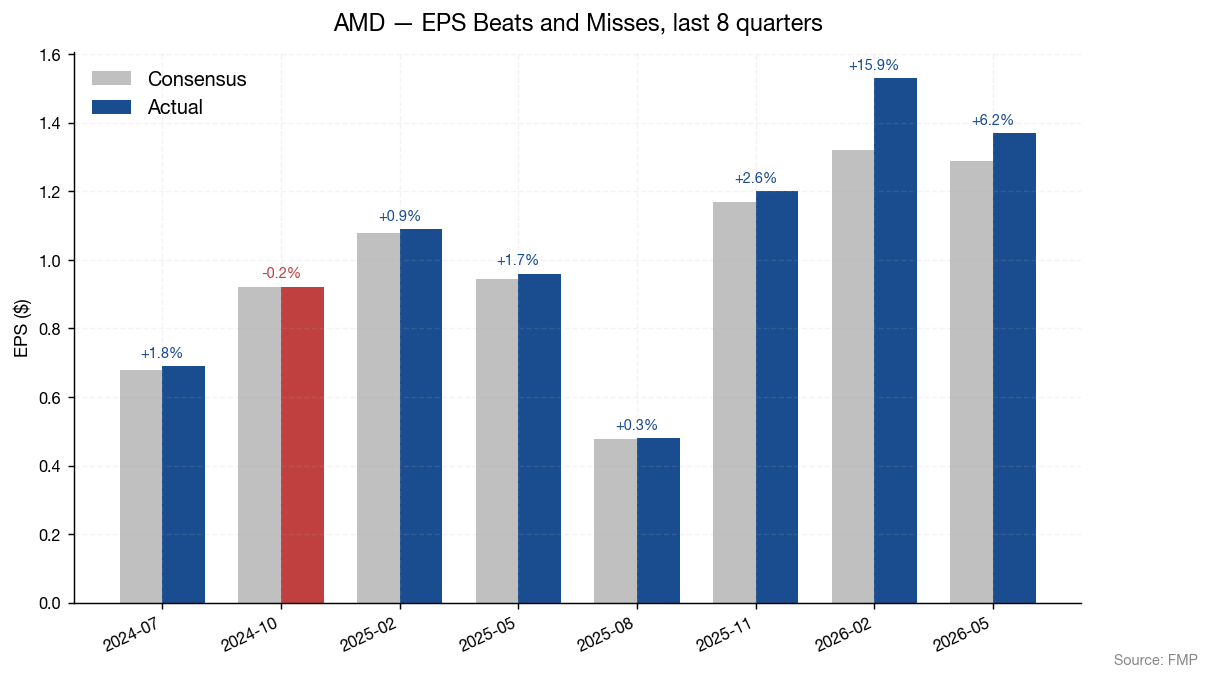
The July revision pattern from the sell-side confirms the direction. Goldman Sachs raised its price target to $640 from $450 on July 5, 2026 (James Schneider, Buy rating). Citigroup upgraded to Buy from Neutral, target $575 from $460, citing the second-source thesis. Stifel set a target of $635 on July 10, 2026. Every meaningful revision in July has been upward, and all of them precede the August 4 Q2 print, which means the sell side is already positioning for a beat and raise.
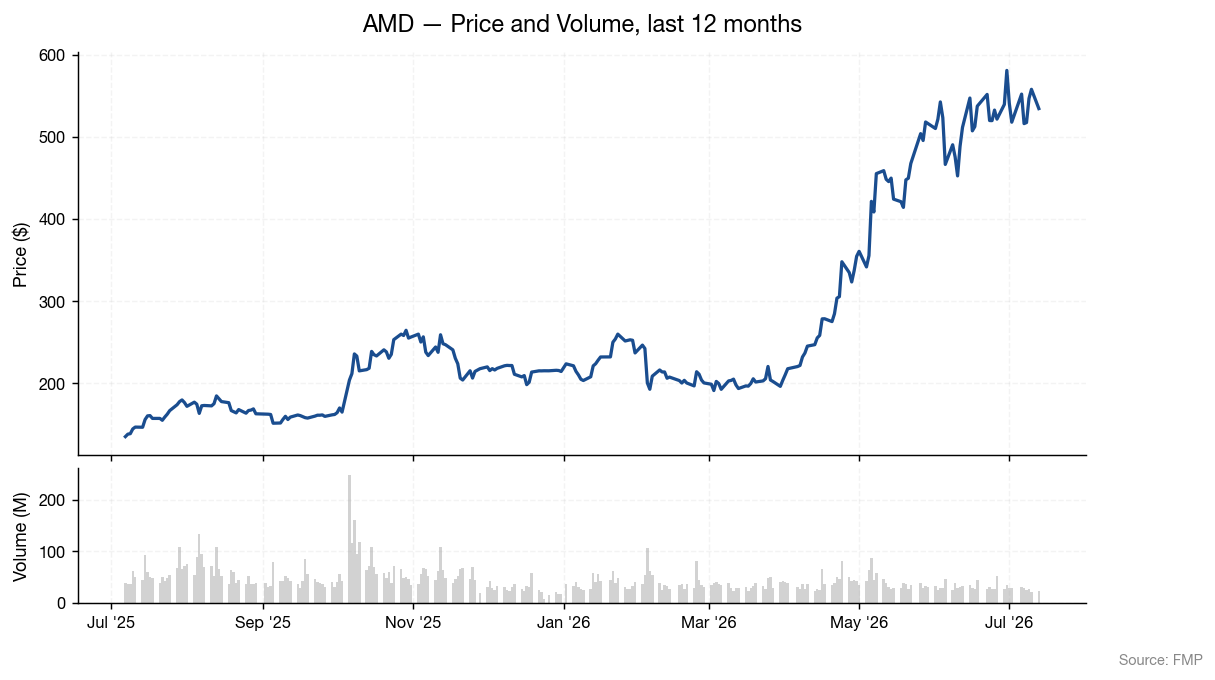
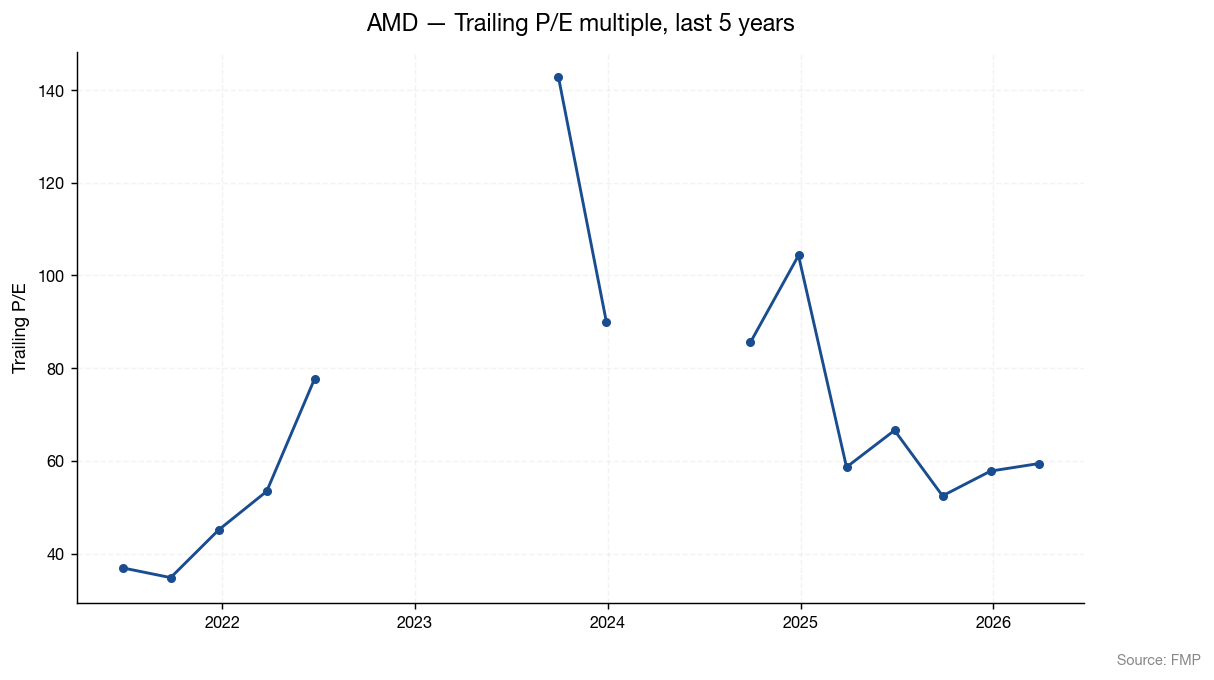
The valuation is what it is. AMD trades at approximately 67 times forward earnings and 12 times forward sales, materially above Nvidia's 17 to 22 times forward P/E. The multiple is stretched. But at the current $557.89 share price and roughly $910 billion market cap, the market is paying for the multi-year trajectory of 12GW of hyperscaler commitments converting to revenue starting in H2 2026 and compounding through 2030. The bull case is not that the multiple is cheap. The bull case is that the multi-year revenue trajectory is bigger than sell-side models currently reflect, and Q2 print + Q3 order commentary are the near-term catalysts that pull those estimates higher.
The Risks
Three risks matter, and I address each honestly rather than hedge.
CUDA still holds training. ROCm has closed the gap in inference but frontier-model training remains an Nvidia domain, particularly for research labs training new foundation models. If the compute mix stays training-heavy through 2027, AMD's total addressable market is smaller than the bull model assumes. My response is that hyperscaler capex is measurably shifting toward inference workloads as the number of deployed AI products scales faster than the number of new foundation models being trained. Meta's 6GW deal is inference-heavy by design.
The valuation multiple is stretched. At 67 times forward earnings, any deployment slip, execution stumble, or Nvidia counter-move can compress the multiple by 30 to 40%. My response is that the multiple compression risk is real but the timing of the compression matters. The August 4 print, the H2 2026 deployment ramps, and the 2027 guidance are the near-term catalysts. Multiple compression from a bad print is possible, but a Q2 beat with strong Q3 order commentary compresses the multiple compression risk rather than triggering it.
Warrant dilution. Combined Meta and OpenAI warrants total approximately 320 million shares, or roughly 20% of current AMD outstanding, vesting on deployment milestones through 2030. That is real GAAP dilution if fully vested. My response is that the warrants only vest if AMD ships the volume that generates the underlying revenue. Dilution and revenue are locked together. Fully vested warrants imply approximately $190 billion of cumulative hardware revenue delivered, and that revenue at 12% net margin (AMD's current run rate) implies approximately $23 billion of net income over the term, which is worth substantially more than the equity dilution cost.
Takeaway
AMD is entering its August 4 Q2 2026 earnings print with 12 gigawatts of committed hyperscaler deployment, the strongest data center guidance in company history at $11.2 billion for the quarter, and a supply-chain reality that structurally protects its share against Nvidia. The multiple is stretched but the multi-year revenue trajectory is real, and every meaningful analyst revision through July has been upward. The next catalyst is 22 days away.
Sources
Research, not a recommendation. Figures are sourced as cited and were current at publication; nothing here is personalized investment advice.